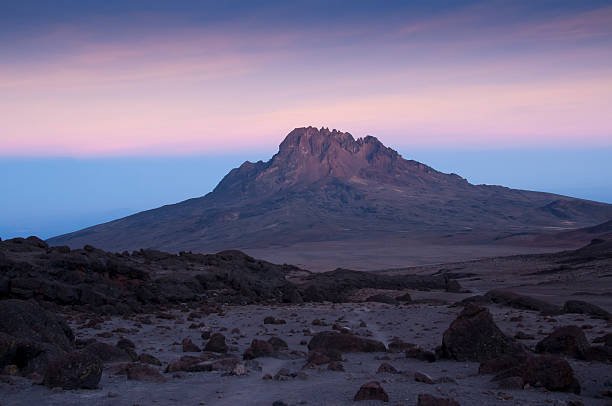
Discover the 7-Day Rongai Route cost for climbing Kilimanjaro in 2026-2027. See the current price, inclusions, exclusions, itinerary, park fees, tips, and booking advice from JoyTrekking Tours & Safaris.
Introduction
Planning to climb Mount Kilimanjaro and wondering about the 7-Day Rongai Route cost? The Rongai Route is one of the most distinctive ways to reach Uhuru Peak because it approaches Africa’s highest mountain from the northern side, close to the Kenya border.
For travelers planning a Kilimanjaro adventure in 2026 or 2027, price is naturally one of the biggest considerations. However, the cheapest quote is not necessarily the best value. A Kilimanjaro package needs to account for park fees, professional mountain guides, porters, food, camping equipment, transfers, safety procedures, accommodation and other operational costs.
For the current JoyTrekking Tours & Safaris Rongai Route package, the listed price is US$2,240 per person for the Rongai Route, with the climbing itinerary structured as 8 Days / 7 Nights. The first day is an arrival and hotel day, followed by seven days on the mountain. JoyTrekking’s published Kilimanjaro route pricing also lists Rongai at US$2,240 for an 8-day/7-night package.
That distinction is important: when travelers search for a “7-day Rongai Route,” they are generally referring to the seven trekking days, while the complete travel package is 8 days and 7 nights when the arrival day is included.
How Much Does the 7-Day Rongai Route Cost in 2026-2027?
The current published price for the Rongai Route with JoyTrekking Tours & Safaris is US$2,240 per person.
Quick price answer
| Package | Duration | Current Published Price |
|---|---|---|
| Rongai Route | 8 Days / 7 Nights | US$2,240 per person |
| Actual mountain trekking | 7 days | Included |
| Arrival day | 1 day | Included |
| Accommodation on arrival | Comfort hotel | Included |
| Mountain accommodation | Camping tents | Included |
This price should be viewed as a published starting/reference price, rather than assuming every future departure will have exactly the same final quotation. Your actual cost can change depending on travel dates, group size, accommodation preferences, additional hotel nights, private arrangements, equipment rental and optional services.
For comparison, JoyTrekking’s published 2026 route pricing lists Marangu at US$1,770, Machame at US$2,160, Umbwe at US$2,180, Rongai at US$2,240, Lemosho at US$2,840 and Northern Circuit at US$2,850.
The Rongai price therefore sits in the middle of the main Kilimanjaro route options: it is more expensive than Marangu, Machame and Umbwe in JoyTrekking’s published comparison, but less expensive than Lemosho and Northern Circuit.
What Does the Rongai Route Price Include?
One of the most important questions to ask when comparing Kilimanjaro prices is not simply “How much does it cost?” but “What am I actually paying for?”
A professional Kilimanjaro package should combine the logistical, operational and safety requirements needed for a serious high-altitude expedition.
The JoyTrekking Rongai package includes:
- Transfer from the hotel to the mountain
- Meals during the trek
- Professional mountain guides
- Porters
- Guide and porter salaries
- Kilimanjaro National Park fees
- Applicable taxes
- Mountain camping accommodation
- Pre-climb arrangements
- Arrival accommodation according to the package itinerary
The published package specifically identifies park fees and taxes, professional guides and porters, mountain meals and hotel-to-mountain transfer among its inclusions.
This matters because park fees alone form a substantial part of a Kilimanjaro climbing package. Tanzania National Parks Authority (TANAPA) publishes official park tariff information and notes that fees can vary according to visitor category and applicable tariff period.
Park Fees and Government Charges
Kilimanjaro is a protected national park, so climbers pay regulated park and conservation-related charges as part of the overall expedition cost.
These costs help cover access to the protected mountain environment and the infrastructure and services associated with operating within the national park.
A major advantage of booking an all-inclusive climbing package is that you do not have to organize these charges individually.
TANAPA is the best external reference for travelers who want to understand official national park tariff information before booking a climb. Its official tariff page explains that park fees are subject to the applicable tariff and visitor category.
Professional Guides and Porters
Your climbing crew is one of the most important parts of your Kilimanjaro experience.
On the Rongai Route, the crew helps with navigation, campsite logistics, meals, equipment, mountain safety and the practical challenges of high-altitude trekking.
Porters also play an important role in carrying group equipment and supplies, allowing climbers to concentrate on trekking rather than carrying a heavy expedition load.
When comparing a US$2,000+ Kilimanjaro package with a much cheaper quotation, check whether the lower price reflects the same crew structure, park charges, meals, accommodation and operational standards.
A very low quote may not represent a true like-for-like comparison.
Rongai Route Cost Breakdown
Although the exact internal cost structure of an operator’s package is not normally published as a line-by-line invoice, your total price can be understood through several major cost categories.
| Cost Component | Included in JoyTrekking Package? |
| Kilimanjaro National Park fees | Yes |
| Applicable taxes | Yes |
| Professional mountain guide | Yes |
| Porters | Yes |
| Mountain meals | Yes |
| Hotel-to-mountain transfer | Yes |
| Mountain camping | Yes |
| Arrival hotel | Yes, according to itinerary |
| International flights | No |
| Tanzania visa | No |
| Travel insurance | No |
| Personal gear | No |
| Crew tips | No |
| Personal snacks/energy bars | No |
| Single supplement | No |
| Portable toilet/shower | No |
This is why travelers should avoid comparing two Kilimanjaro prices based solely on the headline figure.
A US$1,900 quote with multiple compulsory extras may ultimately cost more than a transparent US$2,240 package that includes major mountain expenses.
7-Day Rongai Route vs 8-Day Package: What’s the Difference?
This is an important point for travelers searching online.
The Rongai Route is often marketed as a 7-day Kilimanjaro climb because the mountain trekking itself takes seven days.
However, the JoyTrekking package is structured as:
8 Days / 7 Nights
The reason is simple:
- Day 1: Arrival in Moshi and hotel accommodation
- Days 2-8: Seven days of mountain trekking
Therefore, if you search for “7-Day Rongai Route cost,” you should not automatically assume the trip contains only seven calendar days from airport arrival to departure.
This package gives you an arrival day before the mountain climb, which is useful for briefing, equipment preparation and resting before the trek begins.
Complete 8-Day, 7-Night Rongai Route Itinerary
The following itinerary follows the Rongai package structure offered by JoyTrekking Tours & Safaris.
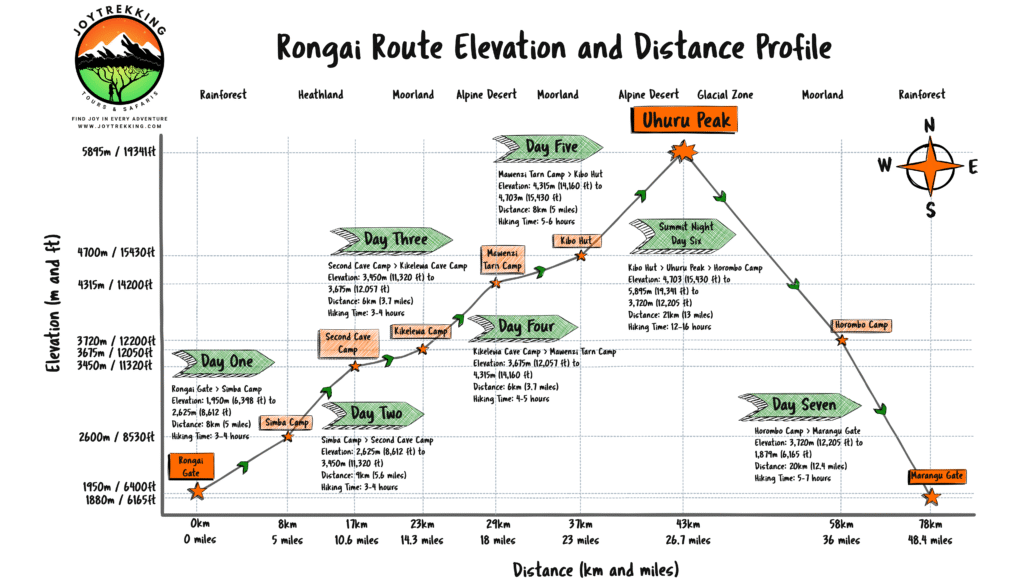
Day 1 – Arrival in Moshi
Your Kilimanjaro adventure begins in Moshi.
After arrival, you meet the team, receive a pre-climb briefing and have time to check your equipment before the trek.
You spend the night at a comfortable hotel and enjoy dinner.
Accommodation: Comfort Hotel
Meals: Dinner
This first night is more than just an accommodation stop. It gives you time to prepare mentally and physically for the mountain.
Day 2 – Rongai Gate to Simba Camp
Elevation: 1,950 m to 2,625 m
Elevation Gain: 675 m
Distance: 8 km
Hiking Time: 3-4 hours
The morning begins with a transfer toward Rongai Gate on the northern side of Kilimanjaro, near the Kenyan border.
Rongai is particularly attractive to travelers looking for a quieter approach to Kilimanjaro. The trail starts through farmland and pine forest before gradually moving toward the mountain environment.
You arrive at Simba Camp after a relatively short first trekking day.
The gradual beginning gives you an opportunity to settle into your walking pace.
Accommodation: Tents
Meals: Breakfast, lunch and dinner
Day 3 – Simba Camp to Second Cave Camp
Elevation: 2,625 m to 3,450 m
Elevation Gain: 825 m
Distance: 9 km
Hiking Time: 3-4 hours
The landscape begins to change as you leave the forest behind.
The trail climbs toward the moorland zone, where vegetation becomes more open and the views across northern Tanzania and Kenya can become increasingly impressive.
Second Cave Camp provides another important night of altitude exposure.
The key lesson on this day is not to rush.
Your guide will encourage a slow and steady walking rhythm, commonly expressed in Tanzania as “pole pole”—slowly, carefully and consistently.
Accommodation: Tents
Meals: Breakfast, lunch and dinner
Day 4 – Second Cave Camp to Kikelewa Cave Camp
Elevation: 3,450 m to 3,675 m
Elevation Gain: 225 m
Distance: 6 km
Hiking Time: 3-4 hours
This is a shorter trekking day, allowing you to continue gaining altitude without covering a huge distance.
The landscape becomes increasingly rugged, with open heathland and views toward Mawenzi.
Kikelewa Cave Camp sits beneath rocky slopes and provides a peaceful location for the night.
One of the major attractions of the Rongai Route is the changing perspective of Mawenzi as you approach it.
Accommodation: Tents
Meals: Breakfast, lunch and dinner
Day 5 – Kikelewa Cave Camp to Mawenzi Tarn Camp
Elevation: 3,675 m to 4,315 m
Elevation Gain: approximately 640-715 m depending on route measurement
Distance: 6 km
Hiking Time: 4-5 hours
The route becomes steeper as you climb toward Mawenzi Tarn.
Mawenzi is Kilimanjaro’s dramatic second volcanic summit, and the landscape around the tarn is among the most memorable sections of the Rongai Route.
The high-altitude environment is rocky and exposed, and the air becomes noticeably thinner.
This is a good time to take acclimatization seriously.
Do not judge your performance by speed. At high altitude, slow walking is not a weakness—it is part of good mountain strategy.
Accommodation: Tents
Meals: Breakfast, lunch and dinner
Day 6 – Mawenzi Tarn Camp to Kibo Hut
Elevation: 4,315 m to 4,703 m
Elevation Gain: 388 m
Distance: 8 km
Hiking Time: 5-6 hours
Today you cross the famous Saddle between Mawenzi and Kibo.
The environment is stark, open and almost lunar.
Vegetation is extremely limited, and the scale of the mountain becomes increasingly dramatic.
You eventually reach Kibo Hut, where you prepare for the summit attempt.
The most important thing to do now is rest.
Your summit attempt will begin during the night, so conserve energy, hydrate and follow your guide’s instructions.
Accommodation: Tents
Meals: Breakfast, lunch and dinner
Day 7 – Summit Day: Kibo Hut to Uhuru Peak to Horombo Hut
Kibo Hut: 4,703 m
Uhuru Peak: 5,895 m
Elevation Gain: 1,192 m
Elevation Loss: 2,175 m
Distance: approximately 21 km
Hiking Time: 12-16 hours
This is the most demanding day of the expedition.
The summit attempt normally begins before midnight.
You climb through darkness toward the crater rim, eventually reaching Gilman’s Point before continuing toward Uhuru Peak, the highest point on Mount Kilimanjaro.
At 5,895 metres (19,341 feet), the altitude is the defining challenge.
If conditions and your physical state allow, you will reach Uhuru Peak around sunrise and have the opportunity to celebrate your achievement.
The descent then continues toward Kibo Hut before proceeding to Horombo Hut.
Accommodation: Tents
Meals: Breakfast, lunch and dinner
The summit day is long, cold and physically demanding. Good preparation, appropriate clothing, hydration, pacing and following your guide’s instructions are essential.
The CDC identifies altitude illness as a major concern for travelers climbing Kilimanjaro and recommends gradual acclimatization and preparation for high-altitude environments.
Day 8 – Horombo Hut to Marangu Gate
Elevation: 3,720 m to approximately 1,870 m
Elevation Loss: approximately 1,850 m
Distance: 20 km
Hiking Time: 5-7 hours
After the summit, you complete your final descent through the lush rainforest toward Marangu Gate.
This section feels dramatically different from the barren high-altitude environment experienced only a day earlier.
After reaching the gate, you receive your summit certificate and celebrate the completion of your Kilimanjaro adventure before returning toward Moshi.
Accommodation: Comfort Hotel
Meals: Breakfast and lunch
Why Is the Rongai Route Different From Other Kilimanjaro Routes?
The biggest difference is its geography.
Rongai approaches Kilimanjaro from the northern side, close to the Kenyan border. It is the only major Kilimanjaro trekking route that begins from this side of the mountain.
The northern approach offers several advantages:
- Generally quieter trekking experience
- More remote atmosphere
- Gradual ascent in the early stages
- Different views of Kilimanjaro
- Excellent views toward Kenya
- Dramatic proximity to Mawenzi
- Descent through the Marangu side of the mountain
Independent route references also describe Rongai as a quieter northern approach with a comparatively gradual ascent.
For travelers who have already experienced busier hiking destinations and want a more peaceful mountain experience, this can be a major reason to choose Rongai.
What Makes the Rongai Route Worth the Price?
At approximately US$2,240 per person, some travelers may initially wonder why a Kilimanjaro climb costs more than an ordinary hiking holiday.
The answer is that climbing Kilimanjaro involves a significant amount of logistics.
Your package supports:
- National park access and fees
- Mountain crew salaries
- Professional guiding
- Porter support
- Food supply and preparation
- Camping logistics
- Transfers
- Hotel accommodation
- Mountain equipment and operational planning
- Safety and emergency preparedness
You are not simply paying someone to take you for a walk.
You are paying for a coordinated high-altitude expedition in a protected mountain environment.
The value becomes even clearer when you consider that the route reaches 5,895 metres, where altitude, cold, weather and fatigue can significantly affect the experience.
Rongai Route Cost Compared With Other Kilimanjaro Routes
If price is your main consideration, it is useful to compare Rongai with other routes.
Based on JoyTrekking’s published 2026 route pricing:
| Route | Duration | Published Price | Main Attraction |
| Marangu | 6 Days / 5 Nights | US$1,770 | Shorter route, hut accommodation |
| Machame | 7 Days / 6 Nights | US$2,160 | Scenic landscapes |
| Umbwe | 6 Days / 5 Nights | US$2,180 | Direct and challenging |
| Rongai | 7 trekking days / 8 Days, 7 Nights package | US$2,240 | Quiet northern approach |
| Lemosho | 8 Days / 7 Nights | US$2,840 | Scenery and longer acclimatization |
| Northern Circuit | 9 Days / 8 Nights | US$2,850 | Longest acclimatization profile |
These are JoyTrekking’s published prices and should be confirmed when requesting your quotation because package rates can change.
Which route gives the best value?
It depends on what you value.
Choose Marangu if keeping the initial package price low and using hut accommodation are your priorities.
Choose Machame if you want spectacular scenery and a popular trekking experience.
Choose Rongai if you want a quieter northern approach and a distinctive mountain experience.
Choose Lemosho if scenery and a longer itinerary are particularly important.
Choose Northern Circuit if maximizing trekking time and gradual acclimatization is your priority.
Price alone should not determine the decision.
What Is Not Included in the Rongai Route Price?
Your budget should include expenses outside the climbing package.
JoyTrekking’s published inclusions and exclusions identify the following as additional costs:
- International flights
- Airport taxes where applicable
- Tanzania visa
- Travel insurance
- Hotel lunch, dinner and drinks outside the specified package meals
- Personal snacks and energy bars
- Personal items
- Tips for the mountain crew
- Personal gear rental or purchases
- Single-room supplement
- Portable toilet and shower
This is an important part of planning your total Kilimanjaro budget.
The US$2,240 package price is not the same thing as your entire trip budget.
What Is Not Included in the Rongai Route Price?
Your budget should include expenses outside the climbing package.
JoyTrekking’s published inclusions and exclusions identify the following as additional costs:
- International flights
- Airport taxes where applicable
- Tanzania visa
- Travel insurance
- Hotel lunch, dinner and drinks outside the specified package meals
- Personal snacks and energy bars
- Personal items
- Tips for the mountain crew
- Personal gear rental or purchases
- Single-room supplement
- Portable toilet and shower
This is an important part of planning your total Kilimanjaro budget.
The US$2,240 package price is not the same thing as your entire trip budget.
Extra Costs to Budget for Your Kilimanjaro Climb
International Flights
Your flights to Tanzania are normally booked separately.
Depending on your origin, season and airline, airfare can vary considerably.
When comparing climbing packages, keep flights separate from the operator’s mountain price.
Tanzania Visa
Many international visitors require a visa to enter Tanzania.
The visa cost depends on nationality and visa category, so travelers should verify the current requirements before departure rather than relying on an old blog or social media post.
Travel Insurance
Travel insurance is particularly important for Kilimanjaro because this is a high-altitude trekking expedition.
Your policy should be checked carefully for:
- High-altitude trekking
- Emergency medical treatment
- Evacuation
- Trip cancellation
- Delayed flights
- Lost or damaged baggage
Do not assume that a standard holiday policy automatically covers a climb to 5,895 metres.
Tips for the Mountain Crew
Crew tips are normally separate from the package price.
Your guide and porter team can have a major impact on your experience, and tipping is an important consideration for many climbers.
Ask your operator before the trek for current guidance on appropriate tipping practices and how tips should be distributed among the crew.
Personal Equipment and Gear Rental
You may already own some Kilimanjaro equipment, but certain items are particularly important.
Your equipment may include:
- Waterproof hiking boots
- Warm sleeping bag
- Thermal base layers
- Fleece
- Insulated jacket
- Waterproof jacket
- Waterproof trousers
- Gloves
- Warm hat
- Headlamp
- Trekking poles
- Sunglasses
- Water bottles or hydration system
- Daypack
- Duffel bag
- Sun protection
If you do not own everything, ask JoyTrekking about available equipment rental before arriving in Tanzania.
Is the Rongai Route Suitable for Beginners?
Yes, the Rongai Route can be suitable for first-time Kilimanjaro climbers, particularly those who are physically prepared and understand that altitude not technical climbing is the major challenge.
Rongai’s relatively gradual northern approach is one reason it appeals to less experienced trekkers. Independent Kilimanjaro route references similarly describe it as a gradual and comparatively beginner-friendly route.
However, beginner-friendly does not mean easy.
The final summit push remains physically demanding, and everyone reacts differently to altitude.
A person with excellent fitness can still experience altitude sickness, while a recreational hiker with appropriate preparation can sometimes perform very well.
How Difficult Is the Rongai Route?
The Rongai Route is best described as moderately difficult, with the summit day being the hardest part.
The challenge comes from several factors:
1. High altitude
Uhuru Peak stands at 5,895 metres.
2. Long summit day
The summit day can take approximately 12-16 hours according to the itinerary.
3. Cold temperatures
Summit night can be extremely cold.
4. Reduced oxygen availability
As altitude increases, the body has to work harder to obtain oxygen.
5. Sleep disruption
You may sleep less comfortably at high altitude.
6. Mental endurance
The final ascent takes place in darkness and can feel very demanding.
This is why good pacing and acclimatization matter so much.
The CDC specifically notes that altitude illness becomes a major concern at elevations above approximately 3,048 metres and recommends gradual acclimatization for travelers going to high altitude.
Best Time to Climb the Rongai Route in 2026-2027
Kilimanjaro can be climbed throughout the year, but weather conditions can influence comfort and trail conditions.
For many international travelers, the more popular climbing periods include:
January to March
This period can offer good trekking conditions, although weather can vary.
June to October
This is another highly popular period because it generally offers favorable trekking conditions.
November to December
Short rains can affect conditions, although the northern side of Kilimanjaro can offer an advantage because Rongai is comparatively drier than some southern approaches.
If you have flexibility, ask your tour operator about the specific month rather than choosing a date solely because it appears cheaper.
How to Save Money Without Compromising Safety
Saving money on Kilimanjaro is possible, but the safest strategy is to reduce unnecessary extras not essential mountain services.
1. Join a group
A group climb can reduce the per-person operational cost compared with a completely private expedition.
2. Travel with your own gear
If you already have suitable trekking equipment, you may reduce rental costs.
3. Compare inclusions
Always compare packages line by line.
4. Avoid unnecessary luxury upgrades
A comfortable hotel before and after your trek may be enough for many travelers.
5. Book early
Early planning gives you more time to compare flights, hotels, insurance and equipment.
6. Do not choose an operator based only on the lowest price
A suspiciously cheap quote deserves careful investigation.
Your mountain guide, crew structure, park fees, food and safety arrangements are not areas where you want to cut corners.
Common Mistakes When Comparing Kilimanjaro Prices
Mistake 1: Comparing a 7-day climb with an 8-day package
Check whether the arrival day is included.
Mistake 2: Looking only at the headline price
Read the inclusions and exclusions.
Mistake 3: Forgetting tips
Crew tips are normally separate.
Mistake 4: Forgetting travel insurance
Insurance should be part of your overall travel budget.
Mistake 5: Assuming every Rongai itinerary is identical
Operators can use different camp arrangements, accommodation standards, group sizes and service levels.
Mistake 6: Prioritizing price over acclimatization
A Kilimanjaro climb is not a normal holiday.
The cheapest itinerary is not necessarily the best itinerary for your personal goals.
Mistake 7: Waiting until the last minute
Popular trekking periods can become busy, especially for travelers seeking specific dates or private departures.
Why Choose JoyTrekking Tours & Safaris?
JoyTrekking Tours & Safaris is a Tanzania-based tour operator offering Kilimanjaro climbing, safari and other Tanzania travel experiences.
For climbers considering Rongai, the company offers a package designed around the northern approach, professional mountain crew, meals, transfers and park fees.
Its published 2026 route comparison lists Rongai at US$2,240 for an 8-day/7-night package, alongside its other major Kilimanjaro routes.
The company also provides different Kilimanjaro route options, allowing travelers to compare Rongai with Machame, Lemosho, Marangu, Umbwe and Northern Circuit before making a final decision.
For a major expedition like Kilimanjaro, travelers should always ask questions about guide experience, crew arrangements, safety procedures, accommodation, meals, park fees and what happens if the itinerary needs to be adjusted.
Rongai Route Cost 2026-2027: Is US$2,240 a Good Price?
For the published JoyTrekking package, US$2,240 per person is a competitive mid-range price for an 8-day/7-night Rongai package, especially when the major mountain operating costs are included.
The strongest value proposition is not necessarily that Rongai is the cheapest route.
It is that you get a distinctive experience:
- Northern approach
- Lower-crowd atmosphere
- Gradual early ascent
- Views toward Kenya
- Mawenzi scenery
- Seven days of mountain trekking
- Descent through the Marangu side
- Professional guide and porter support
- Park fees and taxes included
- Mountain meals included
For travelers who value solitude and a different perspective of Kilimanjaro, that combination can make Rongai an excellent choice.
Frequently Asked Questions About Rongai Route Cost
How much does the 7-Day Rongai Route cost in 2026?
The current published JoyTrekking Tours & Safaris price is US$2,240 per person for the Rongai Route package. The complete package is structured as 8 Days / 7 Nights, including one arrival day and seven days of mountain trekking.
Why is the Rongai Route called a 7-day climb if the package is 8 days?
The seven days refer to the actual mountain trekking itinerary. The eighth calendar day is created by including an arrival day in Moshi before the trek. Therefore, the full package is 8 Days / 7 Nights.
Does the Rongai Route price include park fees?
Yes. The JoyTrekking package lists all applicable park fees and taxes among the inclusions. Official information on Tanzania National Parks tariffs is available through TANAPA.
Are international flights included in the Rongai Route price?
No. International flights are excluded and should be budgeted separately.
Is tipping included in the Rongai Route price?
No. Tips for the climbing crew are listed among the exclusions. Ask your operator for current guidance on appropriate tipping before your climb.
Final Verdict: Should You Book the Rongai Route in 2026-2027?
If you want a quieter, less conventional way to climb Mount Kilimanjaro, the Rongai Route deserves serious consideration.
At the current published US$2,240 per person, the JoyTrekking Tours & Safaris package combines seven days of mountain trekking with an arrival day, making it an 8-day/7-night Kilimanjaro experience. Major components such as park fees, professional guides and porters, mountain meals and mountain transfers are included.
More importantly, the route gives you something that price alone cannot measure: a different side of Kilimanjaro.
You approach from the north, trek through quieter landscapes, experience views toward Kenya, pass beneath the dramatic Mawenzi peak and ultimately cross the mountain toward the Marangu side.
For the right traveler, that combination of price, route character, quieter trails and seven trekking days makes Rongai one of the most compelling Kilimanjaro options for 2026-2027.
Plan Your Rongai Route Climb With JoyTrekking Tours & Safaris
Ready to stand at Uhuru Peak, 5,895 metres above sea level?
Do not choose your Kilimanjaro climb based on price alone. Choose the route that matches your fitness, schedule, acclimatization needs and the type of mountain experience you want.
JoyTrekking Tours & Safaris can help you plan your Rongai Route adventure for 2026 or 2027, including your preferred travel dates, group size, accommodation arrangements and any additional Tanzania safari or Zanzibar plans.
Request your personalized Rongai Route quotation today and start planning your journey to the Roof of Africa.
Book Your Kilimanjaro Adventure | JoyTrekking Tours & Safaris