Menu

JoyTrekking Tours & Safaris

Mount Kilimanjaro Hike Distance: How Far Will You Walk?

Discover how many kilometres it takes to climb Africa’s highest mountain. Compare six Kilimanjaro routes, trailhead elevations, trekking days and package prices before planning your Tanzania adventure.

5,895 mUhuru Peak elevation
53–98 kmApproximate route distances
6 routesCompare your options

Your Kilimanjaro Planning Guide

How Many Kilometres Is the Kilimanjaro Hike?

The total hiking distance on Mount Kilimanjaro depends on the route you choose and the number of days spent on the mountain. Commonly published route distances range from approximately 53 km on Umbwe to around 98 km on the Northern Circuit.

Every standard summit route leads to Uhuru Peak at 5,895 metres (19,341 feet) above sea level. However, the starting altitude, terrain, daily walking distance and opportunities to acclimatise differ from one route to another.

At a Glance

Kilimanjaro Hiking Distance by Route

Compare approximate distances, starting elevations and typical trekking durations.

RouteApprox. DistanceStart Elevation Summit ElevationTypical Duration
Marangu~72 km1,860 m5,895 m5–6 days
Machame~62 km1,640 m5,895 m6–7 days
Umbwe~53 km1,600 m5,895 m5 days
Rongai~73 km1,950 m5,895 m6–7 days
Lemosho~70 km2,100 m5,895 m7–8 days
Northern Circuit~98 km2,100 m5,895 m8–9 days
Important: Distances and trailhead elevations are approximate reference figures. Exact measurements vary by itinerary, route variant and operator. The durations above describe common route ranges; see the package section below for JoyTrekking’s listed itineraries.

The elevation figures in this table refer to the approximate starting point and the summit, not the total amount of uphill climbing during the trek. Climbers ascend and descend between camps at different altitudes.

Explore Your Options

Six Routes to the Roof of Africa

Each Kilimanjaro route offers a different combination of scenery, distance, accommodation and acclimatisation time. The best choice depends on your available time, preferences and preparation.

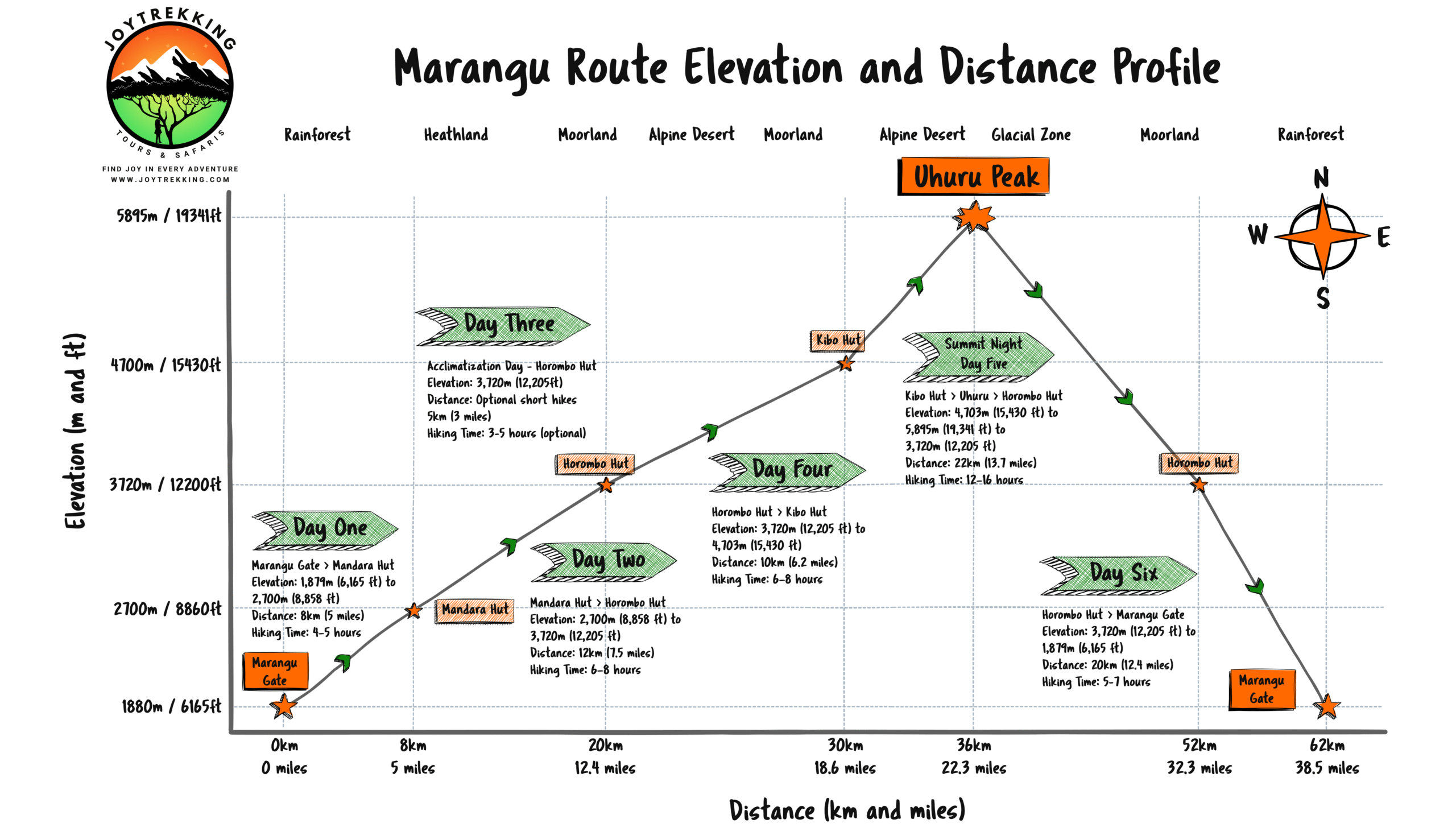
Marangu Route elevation chart showing trekking stages and altitude gain on Mount Kilimanjaro

01 · The Hut Route

Marangu Route — Approximately 72 km

Marangu approaches Kilimanjaro from the southeast. It is known for mountain hut accommodation and uses the same general trail for the ascent and descent. This makes it different from routes that descend by another path.

Start: ~1,860 m Summit: 5,895 m
  • Common duration: 5–6 days
  • Accommodation: Mountain huts
  • Consider: A longer itinerary can allow more time for acclimatisation.
View Marangu package →
7-day Machame Route elevation profile showing trekking stages and altitude gain on Mount Kilimanjaro

02 · The Scenic Classic

Machame Route — Approximately 62 km

Machame approaches from the south and is popular for its varied landscapes. Trekkers pass through changing vegetation zones before entering the higher alpine environment.

Start: ~1,640 m Summit: 5,895 m
  • Common duration: 6–7 days
  • Accommodation: Camping
  • Consider: Compare the available itinerary lengths rather than choosing on distance alone.
View Machame package →
7-day Umbwe Route elevation profile showing trekking stages and altitude gain on Mount Kilimanjaro

03 · The Steep Approach

Umbwe Route — Approximately 53 km

Umbwe is a shorter, steeper approach that gains altitude rapidly. Its lower total distance does not make it an easy option: the ascent profile can be demanding and leaves less time to adjust to altitude on shorter itineraries.

Start: ~1,600 m Summit: 5,895 m
  • Common duration: 5 days
  • Accommodation: Camping
  • Consider: Discuss route suitability and acclimatisation with a qualified operator.
View Umbwe package →
7-day Rongai Route elevation profile showing trekking stages and altitude gain on Mount Kilimanjaro

04 · The Northern Approach

Rongai Route — Approximately 73 km

Rongai approaches Kilimanjaro from the northern side, close to the Kenya border. It offers a different perspective of the mountain from the southern and western routes.

Start: ~1,950 m Summit: 5,895 m
  • Common duration: 6–7 days
  • Accommodation: Camping
  • Consider: Ask about the route’s descent plan and the time available for acclimatisation.
View Rongai package →
7-day Lemosho Route elevation profile showing trekking stages and altitude gain on Mount Kilimanjaro

05 · The Western Approach

Lemosho Route — Approximately 70 km

Lemosho begins on the western side of Kilimanjaro and is valued for its scenic approach. Longer versions provide additional days on the mountain, which can be helpful when planning for gradual acclimatisation.

Start: ~2,100 m Summit: 5,895 m
  • Common duration: 7–8 days
  • Accommodation: Camping
  • Consider: Compare the 8-day itinerary and its inclusions before booking.
View Lemosho package →
Northern Circuit Route elevation profile showing trekking stages and altitude gain on Mount Kilimanjaro

06 · The Long Circuit

Northern Circuit — Approximately 98 km

The Northern Circuit takes a longer path around the mountain, including the quieter northern slopes. Its extended itinerary allows more time on the trek than shorter routes.

Start: ~2,100 m Summit: 5,895 m
  • Common duration: 8–9 days
  • Accommodation: Camping
  • Consider: Suitable for travellers who can set aside more time for the expedition.
View Northern Circuit package →

Images above are illustrative mountain and landscape photographs, not verified photographs of the named Kilimanjaro routes. Replace them with your licensed, route-specific Kilimanjaro photographs when available.

Understanding Altitude

Kilimanjaro Elevation: From the Trailhead to Uhuru Peak

Kilimanjaro’s highest point is Uhuru Peak, at 5,895 metres above sea level. Your starting elevation depends on the route, but every summit itinerary must take you into a high-altitude environment.

Starting Altitude

1,600–2,100 m

Approximate starting elevations across the six routes covered in this guide.

High Camp Zone

About 4,000–4,700 m

Many itineraries spend time at high camps before the summit attempt. Camp elevations vary by route.

The Summit

5,895 m

Uhuru Peak is the highest point on Mount Kilimanjaro and the highest point in Africa.

Altitude matters more than kilometres alone. A shorter route can involve a steep ascent and less acclimatisation time. Choose an itinerary with suitable time for altitude adjustment, and follow your mountain guides’ safety instructions.

Plan Your Climb

Mount Kilimanjaro Packages & Prices

Compare the currently listed JoyTrekking route packages. Your final quotation depends on your group size, travel dates, selected itinerary and the package inclusions confirmed by our team.

Lowest Listed Package

Marangu Route

6 Days / 5 Nights

US$1,770

Listed group-package rate

Explore Route
Popular Scenic Choice

Machame Route

7 Days / 6 Nights

US$2,160

Listed group-package rate

Explore Route
Steep Approach

Umbwe Route

6 Days / 5 Nights

US$2,180

Listed group-package rate

Explore Route
Northern Approach

Rongai Route

7 Days / 6 Nights

US$2,240

Listed group-package rate

Explore Route
Scenic Western Route

Lemosho Route

7 Days / 6 Nights

US$2,840

Listed group-package rate

Explore Route
Longest Listed Itinerary

Northern Circuit

9 Days / 8 Nights

US$2,850

Listed group-package rate

Explore Route
Pricing clarification: These are the published group-package rates for groups starting from 8 climbers, not the price per person for a solo traveller, couple or smaller group. Confirm current availability, inclusions and your final quotation with JoyTrekking before booking.

Make an Informed Choice

Which Kilimanjaro Route Should You Choose?

Use your available time, preferred experience and the itinerary’s acclimatisation profile to guide your decision.

For Hut Accommodation

Consider Marangu if you prefer sleeping in mountain huts rather than camping.

For Varied Scenery

Compare Machame and Lemosho, including the number of days and route profiles.

For More Time on the Mountain

Look at longer itineraries such as Lemosho or the Northern Circuit, subject to your budget and schedule.

No route can guarantee a summit. High altitude affects people differently, regardless of fitness. Speak with your operator about medical preparation, emergency procedures, guide-led monitoring and the itinerary best suited to your circumstances.

Frequently Asked Questions

Mount Kilimanjaro Hike Distance FAQs

How many kilometres is the Mount Kilimanjaro hike?

It depends on the route. Approximate distances in this guide range from about 53 km on Umbwe to around 98 km on the Northern Circuit. Exact distances vary by itinerary.

What is the elevation of Mount Kilimanjaro?

Uhuru Peak, the mountain’s highest point, stands at 5,895 metres (19,341 feet) above sea level.

Which Kilimanjaro route is the longest?

The Northern Circuit is generally the longest standard route, commonly described as approximately 88–98 km depending on the itinerary and how distance is measured.

Is the shortest Kilimanjaro route the easiest?

No. Total distance alone does not determine difficulty. Gradient, daily elevation gain, terrain and time available for acclimatisation all matter. Umbwe is relatively short but is known for its steep approach.

How many days does it take to climb Kilimanjaro?

Many itineraries take around 6–9 days on the mountain, depending on the route. Longer itineraries can provide more time to adjust to altitude. Discuss the safest suitable schedule with your operator.

How much does a Kilimanjaro climb cost with JoyTrekking?

The listed group-package rates in this guide range from US$1,770 to US$2,850 for groups starting from 8 climbers. They are not individual per-person prices. Visit our Kilimanjaro cost guide or request a personalised quote.

Do all Kilimanjaro routes reach the same summit?

The standard summit routes aim for Uhuru Peak at 5,895 metres. They differ in approach, distance, camps, scenery and duration.

Where can I find official Kilimanjaro information?

Visit the Tanzania National Parks Authority (TANAPA) for official park information and guidelines. UNESCO also provides information about Kilimanjaro National Park’s World Heritage status.

Further Reading

Trusted Kilimanjaro Resources

For additional information, consult these recognised sources:

Your Tanzania Adventure Starts Here

Ready to Plan Your Kilimanjaro Climb?

Tell JoyTrekking Tours & Safaris your preferred travel dates, group size and route interests. Our team can help you compare itineraries and request a quotation for your planned climb.