Planning a Great Migration safari in Tanzania? Discover the best months, Serengeti locations, calving season, river crossings and tips for planning your safari.
Experience the Great Migration in Tanzania
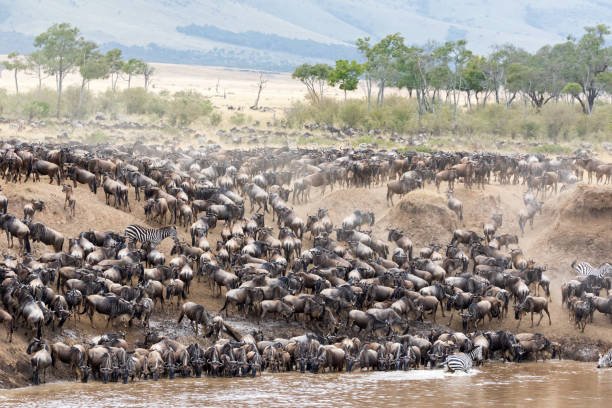
Imagine standing on the endless plains of the Serengeti as thousands of wildebeest move across the landscape, joined by zebras, gazelles and followed by Africa’s great predators.
This is the Great Migration in Tanzania — one of the most remarkable wildlife spectacles on Earth.
But there is something important to understand before planning your trip:
The Great Migration is not a single event that happens in one place on one date.
It is a continuous, seasonal movement of wildlife across the wider Serengeti ecosystem as animals respond to rainfall, fresh grass and water.
UNESCO describes the Serengeti’s annual migration as one of the world’s most impressive natural spectacles, involving vast herds of wildebeest, gazelles and zebras moving through the ecosystem in search of pasture and water.
That is why choosing the right Tanzania Great Migration season depends on what you want to experience.
At JoyTrekking Tours & Safaris, we help international travellers plan their Serengeti safari around the seasonal movement of the herds rather than promising a specific wildlife encounter.
Tell us your travel dates, group size and preferred safari experience, and we’ll help you plan a realistic Tanzania itinerary.
What Is the Great Migration in Tanzania?
The Great Migration is the large-scale annual movement of wildebeest, zebras and gazelles through the Serengeti ecosystem and into Kenya’s Maasai Mara.
UNESCO identifies the Serengeti as the heart of a wider ecosystem supporting one of the world’s largest remaining natural animal migrations. The annual movement covers roughly 1,000 kilometres in a circular pattern across Tanzania and Kenya.
The migration is driven largely by the search for:
- Fresh grass
- Water
- Suitable grazing conditions
- Seasonal rainfall
The exact position of the herds therefore changes throughout the year.
This is why a responsible safari company should discuss seasonality and likely wildlife areas with you rather than guaranteeing that the herds will be in one particular location on a particular day.
When Is the Tanzania Great Migration Season?
There is no single “migration month.”
Different stages of the migration occur at different times of the year.
For travellers planning a Tanzania safari, it is more useful to think of the migration as a year-round cycle with seasonal highlights.
TANAPA currently identifies June to October as an important period for migration viewing during the dry season, while January to February is highlighted as the calving season.
A simplified planning calendar looks like this:
| Period | Migration Experience |
|---|---|
| January–February | Calving season in the southern Serengeti |
| March | Calves and predators remain an important focus |
| April–May | Herds begin moving as seasonal conditions change |
| June | Movement toward western areas and major migration activity |
| July–September | Northern Serengeti and Mara-region movements |
| October | Herds begin moving southward |
| November–December | Return toward the southern Serengeti |
Important: These are broad seasonal patterns, not guaranteed schedules. Rainfall and local conditions can influence where the herds are at any particular time.
January–February: Great Migration Calving Season
If you are interested in seeing young wildebeest and predator activity, the early-year calving season can be an exciting time to visit.
TANAPA identifies January–February as the Serengeti’s calving period.
During this period, large numbers of wildebeest gather in the southern Serengeti and surrounding ecosystem areas where fresh grass provides important nutrition.
The landscape can feel very different from the classic dry-season imagery many travellers associate with the Serengeti.
You may experience:
- Young wildebeest
- Large herds
- Green landscapes
- Predator activity
- Dramatic wildlife interactions
- Fewer dry-season conditions
For travellers who want to understand the ecological side of the migration, calving season offers a completely different perspective.
March–May: Following the Herds
As seasonal conditions change, the herds begin moving through the Serengeti ecosystem.
March can still offer excellent wildlife experiences around the southern plains, while April and May are generally wetter months in many parts of northern Tanzania.
This period can be particularly interesting for travellers who prefer greener landscapes and are comfortable planning around seasonal rainfall.
However, migration location can change from year to year.
For that reason, we recommend discussing your exact travel dates with your safari operator before deciding where to spend the majority of your Serengeti nights.
June–July: The Migration Moves North and West
As the dry season develops, the migration begins moving through different sections of the Serengeti.
TANAPA highlights June–October as a key period for migration viewing.
June can offer dramatic wildlife movement across the western and central Serengeti, while July may bring increasing interest in the northern Serengeti.
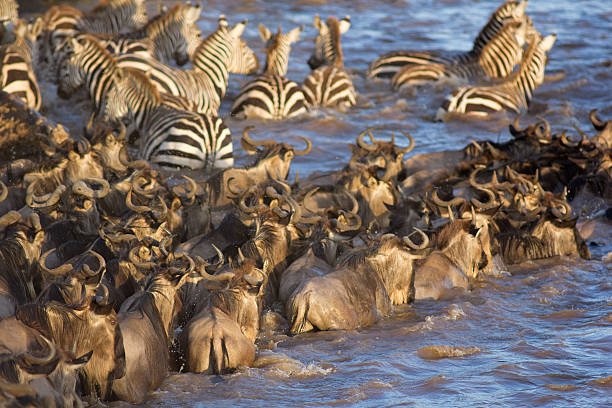
This is also the period when many international travellers begin thinking about the famous river-crossing experience.
But there is an important point:
A river crossing is a natural event, not a scheduled safari attraction.
The herds do not cross simply because a traveller arrives on a particular date.
Their movement depends on environmental conditions and herd behaviour.
August–September: Northern Serengeti and River-Crossing Season
For many travellers, August and September are among the most anticipated months of the migration cycle.
During this period, parts of the migration may be found in the northern Serengeti and toward the Mara ecosystem.
This is when travellers often hope to witness dramatic river crossings.
TANAPA has published specific guidance around the Mara River crossing, reflecting the importance of responsible wildlife viewing during this period.
However, do not book a safari based on a guaranteed river crossing.
Even during the commonly associated months, the timing and location of crossings can change.
A good safari operator should instead help you choose an itinerary that gives you a reasonable opportunity to encounter the migration while also providing excellent wildlife viewing if the herds are elsewhere.
October–December: The Journey South
As conditions change toward the end of the year, the herds gradually begin moving southward again.
October can still provide opportunities in the northern Serengeti, while November and December may see increasing movement toward the central and southern parts of the ecosystem.
This period can be attractive to travellers who want to combine migration-related experiences with a broader Northern Tanzania safari.
December also provides an opportunity to combine a safari with a Christmas or New Year holiday in Tanzania.
Where Can You See the Great Migration in Tanzania?
The most important destination for experiencing the migration in Tanzania is Serengeti National Park.
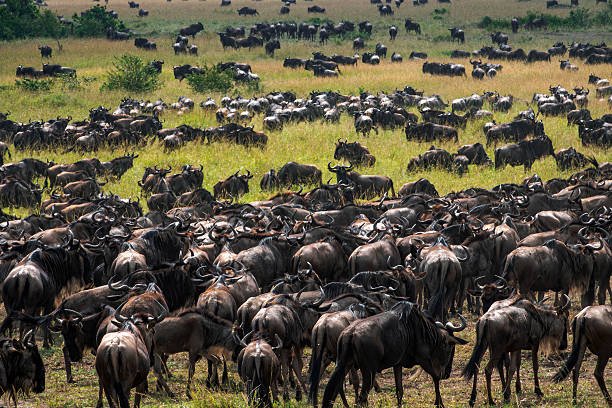
But Serengeti is enormous, and different areas can provide different experiences depending on the season.
Southern Serengeti
Southern Serengeti is particularly associated with the calving season during the early months of the year.
This area can be attractive for travellers interested in:
- Calving
- Large concentrations of wildebeest
- Predator activity
- Open grasslands
- Photography
Central Serengeti
The central Serengeti provides year-round wildlife opportunities and can be an important part of a migration itinerary during several stages of the annual cycle.
It also provides access to some of the Serengeti’s famous landscapes and wildlife areas.
Western Serengeti
The western Serengeti becomes particularly relevant as the herds move toward the western corridor.
This region can provide a different landscape and wildlife experience compared with the central plains.
Northern Serengeti
Northern Serengeti is especially important during the part of the migration cycle when herds move toward the Mara River and the northern ecosystem.
This is where many travellers hope to experience river crossings.
TANAPA lists the Great Migration among Serengeti’s major attractions and identifies game viewing, photography and other wildlife experiences as visitor activities.
What Animals Are Part of the Great Migration?
The wildebeest are the most famous participants, but the migration involves much more than wildebeest.
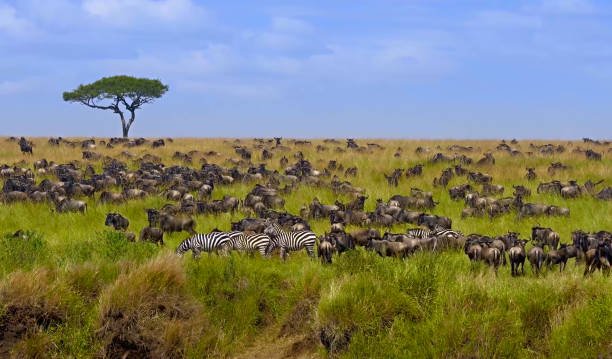
The moving herds include:
- Wildebeest
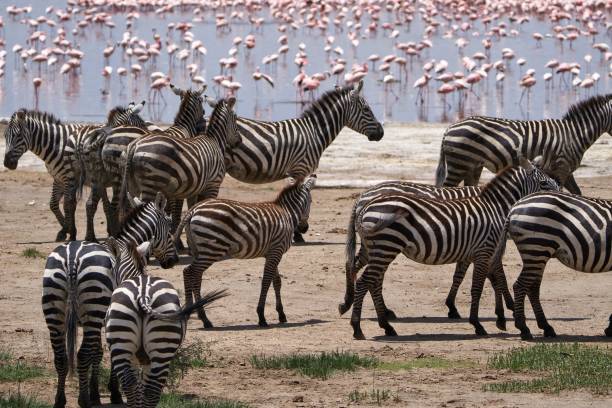
- Zebras
- Thomson’s gazelles
- Other grazing animals
Predators also follow the movement of the herds.
Depending on the area and season, travellers may encounter:
- Lions
- Leopards
- Cheetahs
- Hyenas
- Crocodiles
UNESCO describes the Serengeti as supporting exceptionally large populations of herbivores and major predators, with predator-prey interactions forming an important part of the ecosystem.
This means a Great Migration safari is not simply about counting wildebeest.
It is about observing an entire ecosystem responding to seasonal movement.
Is the Great Migration Worth Planning a Safari Around?
For travellers particularly interested in wildlife and seasonal natural events, the migration can be a major reason to visit northern Tanzania.
However, your safari should not depend entirely on seeing one specific event.
The Serengeti itself offers extraordinary wildlife viewing even when the herds are not concentrated exactly where you expected.
TANAPA describes Serengeti as home to major wildlife populations and the world’s large mammal migration.
A well-designed itinerary can therefore combine migration viewing with:
- Big Five game drives
- Serengeti landscapes
- Ngorongoro Crater
- Tarangire National Park
- Cultural experiences
- Luxury or mid-range lodges
- Bush dining experiences
How Long Should You Spend on a Great Migration Safari?
There is no universal number of days.
Your ideal safari length depends on:
- Your budget
- Travel dates
- Migration location
- Number of parks
- Accommodation style
- Photography interests
- Whether you want a private safari
- Whether you want to include Zanzibar
For travellers specifically targeting the migration, spending several nights in the Serengeti can be more useful than trying to cover too many destinations in a short itinerary.
This gives you more flexibility to respond to wildlife conditions.
Sample 7-Day Tanzania Great Migration Safari
Here is an example of how an international traveller could structure a Northern Tanzania safari.
Day 1 — Arrival in Arusha
Airport transfer and overnight in Arusha.
Day 2 — Tarangire National Park
Morning transfer and game drive among elephants, baobabs and other wildlife.
Day 3 — Ngorongoro Conservation Area
Continue toward Ngorongoro with wildlife and scenic experiences along the way.
Day 4 — Ngorongoro Crater
Full or extended crater wildlife experience before continuing toward Serengeti.
Day 5 — Central Serengeti
Explore the central Serengeti with game drives focused on wildlife and seasonal migration activity.
Day 6 — Serengeti Migration Experience
Spend another full day in the Serengeti, adapting the game-drive area according to current wildlife movements.
Day 7 — Departure
Depending on your flight schedule, depart from Serengeti, Arusha or Kilimanjaro International Airport.
For a migration-focused itinerary, the exact Serengeti region should be selected according to your travel month and the latest available wildlife information.
Great Migration Safari + Zanzibar
One of the biggest advantages of choosing Tanzania is that you can combine your wildlife safari with a tropical island holiday.
After your Serengeti adventure, fly to Zanzibar for:
- Beach relaxation
- Stone Town
- Spice experiences
- Island excursions
- Indian Ocean scenery
A popular international itinerary can therefore look like:
Arrival ? Northern Tanzania Safari ? Great Migration ? Zanzibar ? International Departure
This combination allows you to experience two very different sides of Tanzania during one holiday.
How Much Does a Great Migration Safari Cost?
There is no single price for a Tanzania Great Migration safari.
The cost depends on:
- Travel season
- Number of safari days
- Number of travellers
- Accommodation category
- Private or shared safari
- Park fees
- Internal flights
- Vehicle type
- Guide services
- Serengeti region
- Zanzibar extension
Migration-season safaris can also have different accommodation demand and pricing compared with other periods.
Rather than choosing a safari based only on the cheapest advertised price, compare the complete package.
Ask your safari company:
Is accommodation included?
Are park fees included?
Is airport transfer included?
Is the safari private or shared?
Which Serengeti region will we visit?
How many nights will we spend in Serengeti?
What happens if the migration is in another area?
These questions help international travellers understand exactly what they are booking.
Why You Should Not Expect a Guaranteed River Crossing
This is one of the most important things to understand before booking a Great Migration safari.
The migration follows natural environmental conditions.
Therefore, no responsible safari company can honestly guarantee:
- A river crossing
- A specific herd location
- A specific number of animals
- A predator sighting
Instead, an experienced operator should explain the seasonal pattern and design your itinerary around the best available opportunities.
This is one of the principles we follow at JoyTrekking Tours & Safaris.
We would rather give you realistic expectations than promise a wildlife moment that nature ultimately controls.
How to Choose a Great Migration Safari Company
When planning from overseas, choosing the right operator is one of the most important decisions you will make.
Look for a company that provides:
Transparent Itineraries
You should know where you are going, how long you will stay and what is included.
Clear Communication
Your questions about transport, accommodation, meals, park fees and travel arrangements should receive clear answers.
Local Knowledge
A Tanzania-based team can help interpret seasonal wildlife movement and adjust your itinerary appropriately.
Realistic Expectations
A professional operator should explain that wildlife sightings are never completely guaranteed.
Flexible Planning
Your safari should be designed around your travel dates and priorities rather than simply selling you a fixed itinerary.
Why Plan Your Great Migration Safari With JoyTrekking?
At JoyTrekking Tours & Safaris, we understand that an international traveller is not simply buying a safari vehicle.
You are planning a major international journey.
Our role is to help you understand:
- Where to go
- When to travel
- How long to stay
- Which parks to combine
- What type of accommodation fits your trip
- How to connect your safari with Kilimanjaro or Zanzibar
Most importantly, we believe in setting realistic expectations.
The Great Migration belongs to nature.
Our job is to put you in the right place, at the right time of year, with the right itinerary and experienced local support.
Tanzania Great Migration Season: Quick Planning Guide
| Period | Main Migration Focus | Suggested Area |
|---|---|---|
| January–February | Calving season | Southern Serengeti |
| March | Calving and young animals | Southern/Central Serengeti |
| April–May | Seasonal movement | Central/Western areas |
| June | Movement toward western areas | Western/Central Serengeti |
| July | Northern movement | Northern Serengeti |
| August–September | Northern Serengeti and possible river crossings | Northern Serengeti |
| October | Northern movement and return south | Northern/Central Serengeti |
| November–December | Movement toward southern Serengeti | Central/Southern Serengeti |
Remember: This is a planning framework, not a fixed wildlife calendar. Actual herd movements depend on environmental conditions.
Frequently Asked Questions
What is the best month for the Great Migration in Tanzania?
There is no single best month for everyone. TANAPA highlights June–October for migration viewing and January–February for calving, so the best period depends on which part of the migration you want to experience.
When is the Great Migration calving season?
The main calving period is generally associated with January and February in the southern Serengeti. TANAPA currently identifies January–February as the calving season.
When can I see the wildebeest river crossing?
River crossings are generally associated with the northern Serengeti portion of the migration cycle, particularly around the mid-to-late dry season. However, crossings are unpredictable and cannot be guaranteed.
Is Serengeti open during the whole year?
TANAPA states that Serengeti is open year-round.
Can I combine the Great Migration with Zanzibar?
Yes. A Serengeti safari can be combined with a Zanzibar beach holiday, creating a Tanzania itinerary that includes both wildlife and the Indian Ocean.
How many days do I need for a Great Migration safari?
It depends on your travel dates and priorities. If the migration is your main reason for visiting, several nights in the relevant Serengeti region can give you more flexibility than a very short visit.
Can I see the Big Five during the Great Migration?
The Serengeti supports lions, leopards, elephants, buffalo and rhinos, although individual sightings can never be guaranteed.
Plan Your Great Migration Journey in Tanzania
The Tanzania Great Migration Season is not simply a date on a calendar.
It is a constantly moving natural cycle shaped by rainfall, grass, water and wildlife behaviour.
That is what makes it extraordinary.
From the calving grounds of the southern Serengeti to the northern plains and the Mara River region, every season offers a different perspective on one of Africa’s greatest wildlife journeys.
The key is not simply choosing a month.
It is choosing an itinerary that makes sense for your travel dates, your interests and the natural movement of the animals.
At JoyTrekking Tours & Safaris, we can help you build that journey from the ground up.
JoyTrekking Tours & Safaris
Kilimanjaro Trekking • Tanzania Safaris • Zanzibar Holidays