Discover the best acclimatization strategy for Mount Kilimanjaro. Learn how to prevent altitude sickness, choose the right route, and maximize your chances of reaching Uhuru Peak safely and successfully.
The best acclimatization strategy for Kilimanjaro is to choose a longer route with a gradual ascent profile, preferably 7–9 days, and follow the “climb high, sleep low” principle whenever possible.
Climbing Mount Kilimanjaro is one of the most rewarding trekking experiences in the world. Standing at 5,895 meters (19,341 feet), Kilimanjaro is Africa’s highest mountain and attracts thousands of climbers every year from every corner of the globe. However, while many people focus on physical fitness, hiking gear, and route selection, one factor plays a much bigger role in determining summit success than almost anything else: acclimatization.
The best acclimatization strategy for Kilimanjaro is to ascend slowly, spend additional days on the mountain, stay well hydrated, and choose a route specifically designed to allow your body enough time to adjust to high altitude. Climbers who follow proper acclimatization techniques dramatically improve their chances of reaching Uhuru Peak while minimizing the risks associated with altitude sickness.
According to the scientific guidance provided by the Centers for Disease Control and Prevention (CDC) and the International Society for Mountain Medicine (ISMM), gradual ascent remains the most effective method for preventing altitude-related illnesses. This principle is particularly important on Kilimanjaro because climbers ascend from tropical rainforest to near-arctic conditions in just a few days.
In this comprehensive guide, we’ll explore the best acclimatization strategy for Kilimanjaro, compare popular routes, discuss altitude sickness prevention, and help you choose the itinerary that offers the highest chance of reaching the Roof of Africa successfully.
What Is the Best Acclimatization Strategy for Kilimanjaro?
The short answer is simple:
The best acclimatization strategy for Kilimanjaro is to choose a longer route with a gradual ascent profile, preferably 7–9 days, and follow the “climb high, sleep low” principle whenever possible.
This approach allows your body to adapt to decreasing oxygen levels as you gain elevation. The more time your body has to adjust, the lower your risk of Acute Mountain Sickness (AMS) and the greater your chances of summiting successfully.
Successful acclimatization involves several key components:
Selecting a route with gradual altitude gain
Spending extra days on the mountain
Maintaining proper hydration
Eating enough calories
Walking at a slow pace
Listening to your guide
Monitoring altitude sickness symptoms daily
Many climbers underestimate the effects of altitude because Kilimanjaro is a non-technical mountain. Unlike Everest expeditions that require ropes and advanced mountaineering skills, Kilimanjaro can be climbed by trekkers with moderate fitness. However, altitude affects everyone differently, regardless of age, fitness level, or hiking experience.
Why Acclimatization Matters on Mount Kilimanjaro
One of the biggest challenges on Kilimanjaro is the mountain’s rapid elevation gain.
Most climbers begin around 1,800 meters and attempt to reach nearly 6,000 meters within less than a week. This is much faster than what altitude medicine experts typically recommend for high-altitude adaptation.
At sea level, oxygen concentration allows the body to function efficiently. As elevation increases, atmospheric pressure drops, making oxygen less available. By the time climbers reach Barafu Camp or Kibo Hut, oxygen availability has fallen significantly compared to lower elevations.
The human body responds by:
Increasing breathing rate
Producing more red blood cells
Increasing heart rate
Adjusting blood chemistry
These adaptations require time.
Without adequate acclimatization, climbers may experience symptoms ranging from mild headaches to severe altitude-related illnesses.
Research published by the National Library of Medicine consistently demonstrates that slower ascent rates reduce the incidence of altitude sickness and improve overall safety during high-altitude expeditions.
For this reason, experienced Kilimanjaro operators prioritize acclimatization-focused itineraries rather than the shortest possible routes.
Understanding Altitude Sickness
Altitude sickness is the primary reason climbers fail to reach the summit of Kilimanjaro.
Even physically fit athletes can be affected because altitude sickness is not directly related to fitness.
Symptoms of Acute Mountain Sickness (AMS)
Common symptoms include:
Persistent headache
Dizziness
Fatigue
Nausea
Loss of appetite
Difficulty sleeping
Shortness of breath
These symptoms often begin above 2,500 meters and may worsen as elevation increases.
If symptoms become severe, immediate descent may be necessary.
The World Health Organization (WHO) and altitude medicine specialists emphasize that early recognition and response are critical for preventing serious complications.
Why Kilimanjaro Climbers Are at Risk
Unlike many high-altitude mountains where climbers spend weeks acclimatizing, Kilimanjaro itineraries are relatively short.
This compressed schedule means climbers can ascend faster than their bodies are capable of adapting.
The risk becomes particularly noticeable during summit night when climbers push from approximately 4,600–4,800 meters to 5,895 meters in a single effort.
At this altitude, even routine activities such as walking, drinking water, or putting on gloves can feel surprisingly difficult due to reduced oxygen availability.
Key Principles of Successful Acclimatization
Understanding how acclimatization works helps climbers make better decisions before and during the trek.
Climb High, Sleep Low
One of the most effective acclimatization techniques is known as “climb high, sleep low.”
This strategy involves ascending to a higher elevation during the day and then descending to sleep at a lower elevation.
Many Kilimanjaro routes naturally incorporate this principle.
The Lemosho Route and Northern Circuit Route are especially effective because they include acclimatization opportunities that expose climbers to higher elevations without requiring them to sleep at those heights immediately.
This gradual exposure encourages physiological adaptation while minimizing stress on the body.
Slow and Steady Ascent
Professional Kilimanjaro guides often use the Swahili phrase “Pole Pole,” meaning “slowly slowly.”
This simple concept is one of the most powerful acclimatization tools available.
Walking too fast increases breathing rate, accelerates fatigue, and may worsen altitude symptoms.
Climbers who maintain a consistent, moderate pace generally perform better than those attempting to move aggressively.
Hydration and Nutrition
Proper hydration supports circulation and helps reduce some altitude-related symptoms.
Most guides recommend consuming 3–4 liters of water daily during the trek.
Equally important is maintaining adequate caloric intake.
Many climbers lose appetite at higher elevations, but eating enough carbohydrates helps support energy production and acclimatization.
According to recommendations from the UIAA Medical Commission, hydration and nutrition play an important supportive role in high-altitude performance.
Extra Days on the Mountain
The single most effective acclimatization strategy is adding extra days.
Every additional day allows the body more time to adapt.
This is why longer routes consistently achieve higher summit success rates than shorter itineraries.
A six-day climb may seem attractive due to lower cost and reduced vacation time, but climbers often sacrifice acclimatization opportunities in the process.
The result is a lower probability of reaching Uhuru Peak.
Comparing Kilimanjaro Routes for Acclimatization
Not all Kilimanjaro routes are created equal.
Some routes were designed primarily for speed, while others prioritize gradual altitude adaptation.
The table below compares the major routes offered by JoyTrekking Tours & Safaris.
Among these options, the Northern Circuit Route is widely considered the best route for acclimatization because it provides the longest itinerary and the most gradual ascent profile.
Closely behind is the Lemosho Route, which has become one of the most recommended routes for climbers seeking both scenic beauty and strong summit success rates.
For travelers whose primary goal is reaching Uhuru Peak safely, these longer itineraries generally offer the best balance between adventure and acclimatization.
Which Kilimanjaro Route Has the Highest Summit Success Rate?
When discussing the best acclimatization strategy for Kilimanjaro, one of the most important questions travelers ask is:
Which route gives me the highest chance of reaching Uhuru Peak?
The answer is closely tied to acclimatization.
In general, routes that provide more days on the mountain and a gradual altitude profile achieve significantly higher summit success rates than shorter itineraries.
Although success rates vary between operators, guide experience, weather conditions, and individual climber health, the overall trend remains consistent across the Kilimanjaro industry.
Approximate Summit Success Rates by Route
Route
Duration
Typical Summit Success Rate
Umbwe Route
6 Days
60–70%
Marangu Route
5–6 Days
50–70%
Machame Route
7 Days
80–90%
Rongai Route
7 Days
80–90%
Lemosho Route
8 Days
90–95%
Northern Circuit Route
9 Days
95%+
The key reason for these differences is acclimatization time.
Many travelers mistakenly choose the shortest route because they assume fewer days mean an easier climb. In reality, the opposite is often true.
Short routes force climbers to gain altitude quickly, reducing the body’s ability to adapt. Longer routes allow the physiological changes needed for successful acclimatization to occur gradually.
For climbers whose primary goal is standing on the summit rather than simply attempting the climb, investing in additional trekking days is usually the smartest decision.
Why the Northern Circuit Route Is Considered the Best for Acclimatization
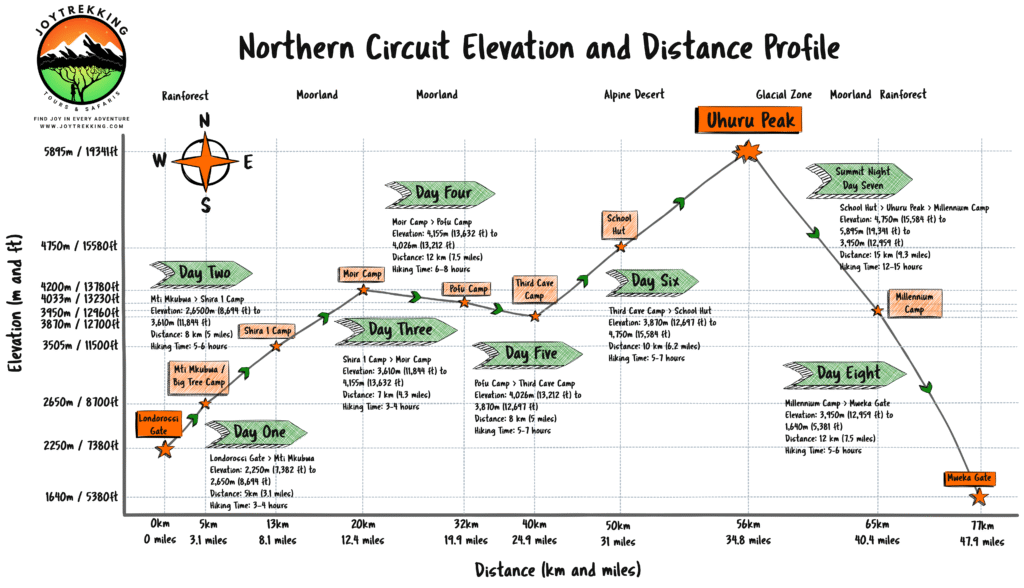
Detailed elevation and distance breakdown for the 9 Days Northern Circuit Kilimanjaro trek itinerary, showing daily ascent profile, hiking distances, and acclimatization pattern from Moshi to Uhuru Peak.
Among all Kilimanjaro routes, the Northern Circuit Route is often regarded as the gold standard for acclimatization.
Several factors contribute to its reputation.
First, it offers the longest itinerary available on Kilimanjaro, typically lasting nine days and eight nights. This extended schedule dramatically reduces daily altitude gain compared to shorter routes.
Second, the route circles the quieter northern slopes of the mountain, providing gradual elevation increases and multiple opportunities for acclimatization before summit night.
Third, the route naturally incorporates the “climb high, sleep low” principle that altitude experts recommend.
Benefits of the Northern Circuit Route include:
Highest summit success rates
More acclimatization days
Less crowded trails
Diverse scenery
Reduced physical stress
Better recovery opportunities
For climbers traveling from sea-level locations who have never experienced high altitude before, the Northern Circuit Route offers one of the safest and most effective approaches to Uhuru Peak.
Why the Lemosho Route Is a Favorite Among Experienced Climbers
While the Northern Circuit offers the best acclimatization profile overall, the Lemosho Route is often considered the best balance between scenery, success rate, and duration.
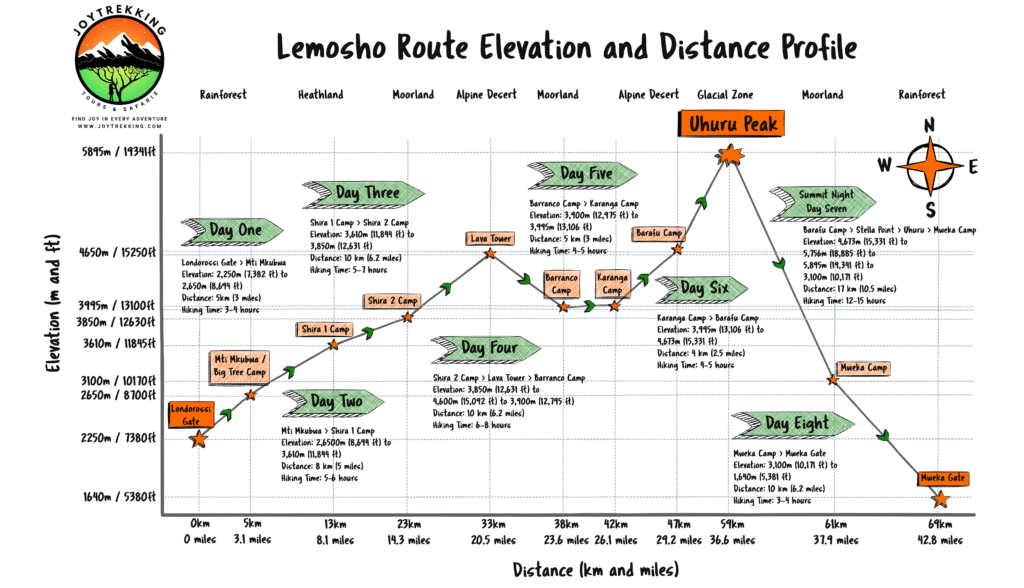
The Lemosho Route itinerary chart on Mount Kilimanjaro National Park illustrates its gradual elevation gain and distance progression, improving acclimatization and increasing summit success rates
Many experienced guides recommend Lemosho because it combines:
Excellent acclimatization opportunities
Stunning landscapes
High summit success rates
Moderate trek duration
The route begins on Kilimanjaro’s western side and gradually approaches the mountain before joining the Machame Route.
One of the most valuable acclimatization features of the Lemosho Route is the trek through the Lava Tower area.
This section exposes climbers to significantly higher elevations during the day before descending to sleep at a lower camp.
The body benefits from the altitude exposure while minimizing overnight stress.
For many travelers, the Lemosho Route represents the ideal compromise between adventure and summit success.
Recommended Acclimatization Itineraries
Best Option for Maximum Summit Success
Northern Circuit Route – 9 Days
Day 1: Londorossi Gate to Mti Mkubwa Camp
Day 2: Mti Mkubwa Camp to Shira Camp
Day 3: Shira Camp to Shira 2 Camp
Day 4: Acclimatization via Lava Tower
Day 5: Northern Slopes Trek
Day 6: Buffalo Camp
Day 7: Third Cave Camp
Day 8: School Hut
Day 9: Summit and Descent
This itinerary provides the most gradual ascent available on Kilimanjaro.
Best Balance of Time and Success
Lemosho Route – 8 Days
Excellent acclimatization profile
Scenic western approach
Strong summit success rates
Ideal for first-time high-altitude trekkers
Best Mid-Range Choice
Machame Route – 7 Days
Often called the “Whiskey Route,” Machame is one of Kilimanjaro’s most popular routes because it combines scenic beauty with relatively strong acclimatization opportunities.
For climbers with limited vacation time, the seven-day Machame itinerary is often a better choice than the six-day version.
Adding one extra day significantly improves acclimatization outcomes.
Common Acclimatization Mistakes Climbers Make
Even with a good route, climbers sometimes undermine their acclimatization efforts through avoidable mistakes.
Choosing the Cheapest Route Instead of the Best Route
Budget-conscious travelers frequently select shorter itineraries to save money.
However, the difference between a six-day climb and an eight-day climb can dramatically affect summit success.
A failed summit attempt often costs more emotionally and financially than investing in a better itinerary from the start.
Walking Too Fast
Many first-time climbers underestimate the importance of pacing.
The most successful summit teams are rarely the fastest.
Guides on Kilimanjaro intentionally maintain a slow pace because conserving energy and supporting acclimatization are more important than covering distance quickly.
Not Drinking Enough Water
Dehydration can mimic or worsen altitude sickness symptoms.
Climbers should drink consistently throughout the day, even when they do not feel thirsty.
Monitoring urine color is a simple way to assess hydration levels.
Ignoring Early Symptoms
Some climbers try to push through headaches or nausea because they fear being turned around.
This can be dangerous.
Early reporting allows guides to assess symptoms and make appropriate adjustments before conditions worsen.
Poor Sleep Before the Trek
Acclimatization begins with arriving rested.
Travelers who arrive exhausted from long international flights may start the climb at a disadvantage.
Whenever possible, spending an extra day in Moshi before beginning the trek can improve overall readiness.
Expert Tips from Kilimanjaro Guides
Experienced Kilimanjaro guides often observe patterns among successful climbers.
Here are some of the most valuable recommendations they consistently share.
Arrive Early in Tanzania
Spend at least one or two days in Moshi before the climb.
This allows your body to recover from travel and gives you time to organize gear properly.
Focus on Consistency Rather Than Speed
The summit is not won during the first few days.
Successful climbers conserve energy throughout the trek and remain patient.
Eat Even When You Don’t Feel Hungry
Altitude often suppresses appetite.
However, your body requires calories to adapt and perform.
Carbohydrates are particularly helpful during high-altitude trekking.
Listen to Your Guides
Professional guides monitor climbers daily.
They understand altitude-related symptoms and have extensive experience managing acclimatization challenges.
Ignoring guide advice is one of the most common mistakes unsuccessful climbers make.
Choose a Longer Route Whenever Possible
If budget and schedule allow, selecting an 8-day or 9-day itinerary often provides the greatest return on investment in terms of summit success.
Acclimatization and Physical Fitness: What’s More Important?
Many people assume that elite athletes have no difficulty on Kilimanjaro.
In reality, altitude does not discriminate.
Marathon runners, cyclists, and professional athletes can develop altitude sickness just as easily as recreational hikers.
Physical fitness remains important because it improves endurance and recovery.
However, acclimatization is often the deciding factor at high altitude.
A moderately fit climber on an 8-day itinerary frequently has a higher chance of summiting than an elite athlete attempting a compressed schedule.
The mountain rewards patience more than raw athletic ability.
Is Altitude Medication Necessary?
Some climbers choose to use medications such as acetazolamide (Diamox) under medical supervision.
The medication may help accelerate acclimatization and reduce symptoms of Acute Mountain Sickness.
However, medication should never replace proper acclimatization practices.
Travelers should consult a qualified healthcare professional before taking any altitude-related medication.
The safest approach combines:
A longer itinerary
Slow ascent
Adequate hydration
Proper nutrition
Professional guide support
Medication, when appropriate, serves as an additional tool rather than a substitute.
Frequently Asked Questions
What is the best acclimatization route on Kilimanjaro?
The Northern Circuit Route is generally considered the best acclimatization route because it offers the longest and most gradual ascent profile.
How many days are best for acclimatization on Kilimanjaro?
Eight to nine days provide significantly better acclimatization compared to five or six-day itineraries.
Is the Lemosho Route good for acclimatization?
Yes. The Lemosho Route is one of the best routes for acclimatization and consistently achieves high summit success rates.
Can fit people still get altitude sickness?
Absolutely. Physical fitness does not guarantee protection against altitude sickness.
How much water should I drink while climbing Kilimanjaro?
Most climbers should aim for approximately 3–4 liters per day, depending on conditions and guide recommendations.
Is Diamox required for Kilimanjaro?
No. Many climbers successfully summit without Diamox, although some choose to use it after consulting a medical professional.
Which route offered by JoyTrekking Tours & Safaris has the best summit success rate?
The Northern Circuit Route and Lemosho Route are generally considered the strongest choices for acclimatization and summit success.
What is the biggest mistake climbers make on Kilimanjaro?
Choosing a route that is too short and ascending too quickly are among the most common reasons climbers fail to reach the summit.
Plan Your Kilimanjaro Adventure with JoyTrekking Tours & Safaris
Choosing the right acclimatization strategy can make the difference between turning around early and standing proudly on Uhuru Peak.
At JoyTrekking Tours & Safaris, we recommend routes that prioritize safety, acclimatization and summit success. Whether you choose the scenic Lemosho Route, the popular Machame Route, or the highly successful Northern Circuit Route, our experienced mountain guides are committed to helping you achieve your Kilimanjaro dream.
Our Kilimanjaro Climbing Packages
Route
Duration
Price
Marangu Route
6 Days / 5 Nights
$1,770
Machame Route
7 Days / 6 Nights
$2,160
Umbwe Route
6 Days / 5 Nights
$2,180
Rongai Route
7 Days / 6 Nights
$2,240
Lemosho Route
8 Days / 7 Nights
$2,840
Northern Circuit Route
9 Days / 8 Nights
$2,850
Our Customers Reviews
Madeline Wayne2024.12.20
Loved January, Ely, Christian, Filbert, Emmanuel, Elias, and the whole crew. Excellent trip led by excellent people. Whole-heartedly recommend this local company with local guides and porters.
Contact JoyTrekking Tours & Safaris today to receive a personalized itinerary, expert route recommendations, and a free quotation tailored to your travel dates and goals.
Book Your Kilimanjaro Adventure Today and Maximize Your Summit Success with the Right Acclimatization Strategy.