Discover Kilimanjaro success rates by route, compare Marangu, Machame, Lemosho, Rongai, Umbwe, and Northern Circuit, and choose the best climb for your adventure with JoyTrekking Tours & Safaris.
Kilimanjaro Success Rates by Route: Which Route Gives You the Best Chance of Reaching the Summit?
Standing at 5,895 meters (19,341 feet) above sea level, Mount Kilimanjaro is the highest mountain in Africa and one of the world’s most iconic trekking destinations. Every year, thousands of climbers travel to Tanzania with one dream to stand on Uhuru Peak and watch the sunrise from the Roof of Africa.
One of the most common questions travelers ask before booking their adventure is:
“Which Kilimanjaro route has the highest success rate?”
The answer isn’t as simple as choosing the easiest trail. Your chances of reaching the summit depend on several factors, including the route you choose, the number of days spent acclimatizing, your physical preparation, altitude adaptation, weather conditions, and the experience of your mountain crew.
At JoyTrekking Tours & Safaris, we’ve guided climbers from around the world to the summit through carefully designed itineraries that maximize acclimatization and safety. In this guide, we’ll compare the success rates of every major Kilimanjaro route, explain why some routes outperform others, and help you choose the best option for your adventure.
What Is the Success Rate of Climbing Kilimanjaro?
Quick Answer
Overall, Mount Kilimanjaro has an average summit success rate of approximately 65%, but this figure varies significantly depending on the route and itinerary. Routes that allow more time for acclimatization such as theNorthern Circuitand Lemosho Route can achieve success rates exceeding 90%, while shorter itineraries often have much lower success rates.
The main reason climbers fail to reach the summit is altitude sickness, not lack of fitness. Many trekkers underestimate the effects of high altitude, which is why choosing a route with gradual elevation gain is one of the most important decisions you’ll make.
The table below compares the six main Kilimanjaro routes based on estimated summit success rates, trip duration, difficulty, acclimatization, and the packages offered by JoyTrekking Tours & Safaris.
Route
Duration
Estimated Success Rate
Difficulty
Acclimatization
Price
Marangu Route
7 Days / 6 Nights
70–80%
Moderate
Good
US$1,770
Machame Route
8 Days / 7 Nights
85–90%
Moderate to Challenging
Very Good
US$2,160
Umbwe Route
7 Days / 6 Nights
60–70%
Challenging
Limited
US$2,180
Rongai Route
8 Days / 7 Nights
80–90%
Moderate
Very Good
US$2,240
Lemosho Route
8 Days / 7 Nights
90–95%
Moderate
Excellent
US$2,840
Northern Circuit
9 Days / 8 Nights
95%+
Moderate
Outstanding
US$2,850
Expert Insight: While no operator can guarantee that every climber will reach Uhuru Peak, choosing a longer itinerary with better acclimatization dramatically improves your chances of success. Investing in an extra day on the mountain often makes a bigger difference than investing in expensive gear.
Why Some Routes Have Higher Success Rates
If all routes lead to the same summit, why do some consistently record much higher success rates than others?
As you climb higher, the amount of oxygen available in the air decreases. At the summit of Kilimanjaro, there is roughly half the oxygen available compared to sea level. Your body needs time to adapt to these changes, producing additional red blood cells and adjusting to the thinner air.
Routes that ascend gradually and include additional trekking days allow your body to adapt naturally, reducing the risk of Acute Mountain Sickness (AMS). This is why longer routes consistently outperform shorter ones.
Other factors that influence summit success include:
Total number of trekking days.
Daily altitude gain.
“Climb high, sleep low” opportunities.
Rest and hydration.
Pace set by experienced guides.
Overall health and preparation.
Experienced mountain guides also play a crucial role. They monitor climbers for signs of altitude sickness, adjust the pace when necessary, and encourage regular hydration all of which contribute to safer and more successful summit attempts.
Marangu Route Success Rate
Often called the “Coca-Cola Route,” the Marangu Route is Kilimanjaro’s oldest and most established trail. It is the only route that offers accommodation in mountain huts instead of tents, making it a popular choice for climbers seeking more comfort.
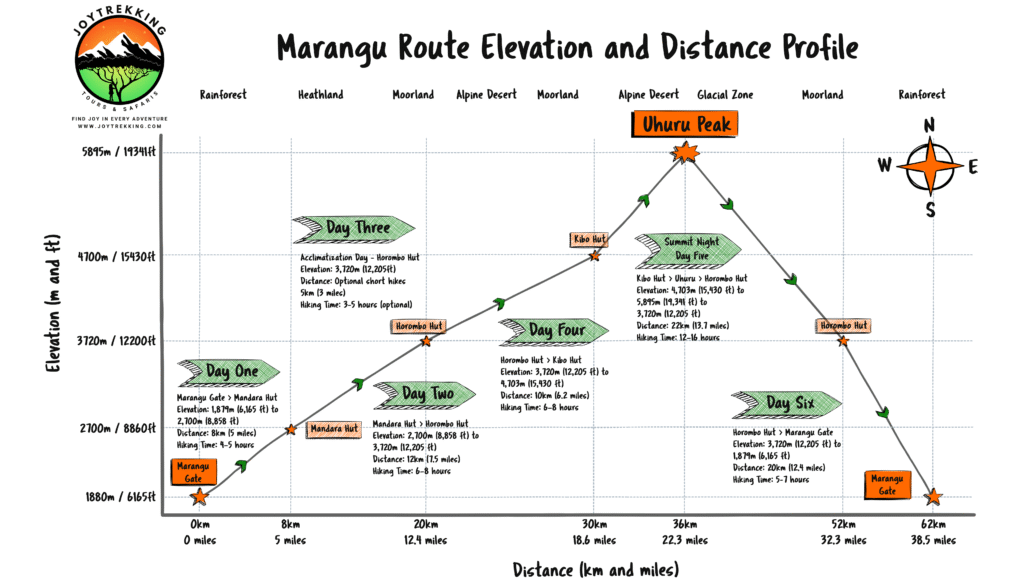
The Marangu Route is one of the most popular Mount Kilimanjaro climbing routes, featuring hut accommodation and a gradual trekking path. This elevation profile shows daily hiking stages, altitude progression, and the journey from the trailhead to Uhuru Peak.
With JoyTrekking Tours & Safaris, the Marangu Route is offered as a 6 Days / 5 Nights itinerary, giving climbers an additional acclimatization day compared to the shorter 5- or 6-day versions. This significantly improves the likelihood of reaching the summit.
Estimated Summit Success Rate
70–80% (6-day itinerary)
The longer 6 -day schedule provides more time for your body to adjust to the altitude, making it a much better option than the shorter itineraries that many budget operators promote.
Why the Success Rate Is Moderate
Although the trail itself is relatively straightforward, the Marangu Route follows the same path for both ascent and descent. This means there are fewer opportunities to follow the important acclimatization principle of “climb high, sleep low,” which helps the body adapt more effectively to altitude.
Even so, with an extra acclimatization day, a steady hiking pace, and experienced guides, many trekkers successfully reach Uhuru Peak.
Pros
Comfortable mountain huts instead of tents
Well-established trail with clear paths
Suitable for first-time trekkers in good health
One of the more affordable Kilimanjaro routes
Ideal during the rainy season due to hut accommodation
Cons
Less effective acclimatization profile
Can become busy during peak climbing seasons
Lower success rate than Lemosho or Northern Circuit
Who Should Choose Marangu?
The Marangu Route is an excellent option for travelers who:
Prefer sleeping in huts rather than tents
Want a comfortable trekking experience
Are looking for a budget-friendly Kilimanjaro climb
Have limited trekking experience but are physically prepared
JoyTrekking Tours & Safaris Package
Route
Duration
Price
Marangu Route
6 Days / 5 Nights
US$1,770
Our 6-day itinerary is carefully designed to maximize acclimatization while maintaining a comfortable pace, giving climbers a much better chance of standing on Africa’s highest point.
Machame Route Success Rate
The Machame Route, often referred to as the “Whiskey Route,” is widely regarded as one of the best all-around options for climbing Mount Kilimanjaro. It combines spectacular scenery, excellent acclimatization, and a rewarding trekking experience.
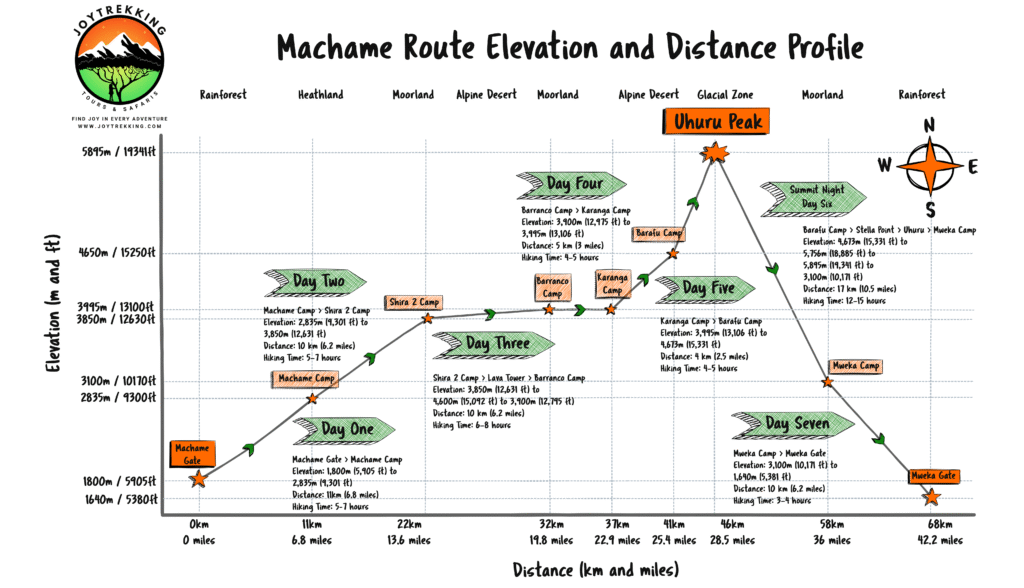
Machame Route Elevation Profile and 8-Day Kilimanjaro Trekking Stages
For many experienced guides, this route offers the ideal balance between challenge and summit success.
At JoyTrekking Tours & Safaris, our 7 Days / 6 Nights Machame Route allows climbers ample time to acclimatize before attempting the summit.
Estimated Summit Success Rate
85–90%
This impressive success rate is one of the reasons why Machame is consistently recommended for first-time climbers who are reasonably fit.
Why Machame Performs So Well
The route follows the highly effective “climb high, sleep low” strategy. Climbers gain altitude during the day before descending slightly to sleep at a lower elevation, allowing the body to adjust more naturally.
This gradual acclimatization significantly reduces the risk of altitude sickness and increases the likelihood of reaching Uhuru Peak.
Scenic Highlights
The Machame Route is known for its incredible variety of landscapes, including:
Dense rainforest
Moorland and giant heather
Shira Plateau
Lava Tower
Barranco Wall
Alpine desert
Arctic summit zone
Many climbers consider it the most scenic route on Kilimanjaro.
Pros
Excellent acclimatization profile
High summit success rate
Spectacular scenery
Diverse landscapes
Suitable for adventurous first-time climbers
Cons
More physically demanding than Marangu
Camping required throughout the trek
Popular during peak seasons
Who Should Choose Machame?
Machame is ideal for travelers who:
Want one of the highest success rates
Enjoy camping
Appreciate dramatic scenery
Are reasonably fit and active
Want great value for money
JoyTrekking Tours & Safaris Package
Route
Duration
Price
Machame Route
7 Days / 6 Nights
US$2,160
Our experienced mountain crew carefully monitors your health, hydration, and pace throughout the climb, helping maximize your chances of a successful summit.
Lemosho Route Success Rate
If your primary goal is to maximize your chances of reaching Uhuru Peak, the Lemosho Route is one of the finest choices available.
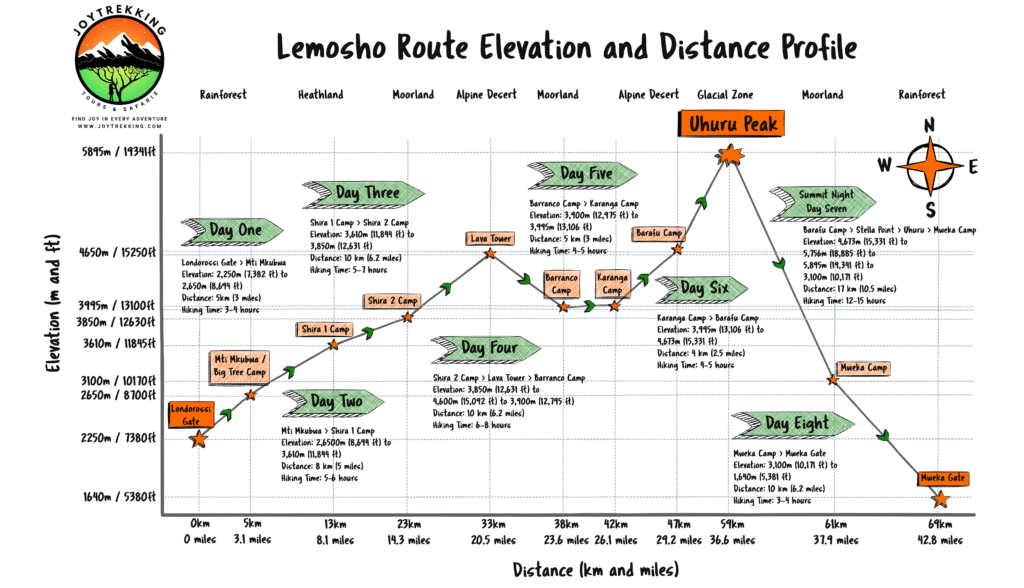
The Lemosho Route is one of the most scenic and successful Mount Kilimanjaro climbing routes. This elevation chart shows daily trekking stages, altitude progression, hiking distances, overnight camps, and the acclimatization profile that helps climbers prepare for the journey to Uhuru Peak.
Known for its outstanding acclimatization profile, breathtaking scenery, and relatively quiet trails during the early days of the trek, Lemosho is frequently recommended by experienced guides and mountaineers.
With JoyTrekking Tours & Safaris, the Lemosho Route is offered as an 8 Days / 7 Nights adventure designed to provide an optimal balance between acclimatization and trekking enjoyment.
Estimated Summit Success Rate
90–95%
Among the classic Kilimanjaro routes, Lemosho consistently ranks among the highest for summit success thanks to its gradual ascent and well-paced itinerary.
Why Lemosho Has One of the Highest Success Rates
Unlike shorter routes, Lemosho begins on the western side of Mount Kilimanjaro and spends several days gaining elevation gradually.
The route offers excellent opportunities to:
Adapt to higher altitude
Maintain a comfortable hiking pace
Stay well-rested before summit night
Experience the “climb high, sleep low” approach
These factors greatly reduce the risk of altitude sickness.
Scenic Highlights
Many trekkers consider Lemosho to be Kilimanjaro’s most beautiful route.
Highlights include:
Untouched rainforest
Shira Plateau
Lava Tower
Barranco Valley
Karanga Valley
Spectacular sunset viewpoints
Panoramic summit sunrise
The route also provides excellent opportunities to spot wildlife near the lower slopes, including colobus monkeys and various bird species.
Pros
One of the highest summit success rates
Exceptional acclimatization
Less crowded during the first half of the trek
Stunning scenery from start to finish
Excellent for photographers
Cons
Higher cost than shorter routes
Longer trekking duration
Camping throughout the expedition
Who Should Choose Lemosho?
The Lemosho Route is perfect for travelers who:
Want the best balance of scenery and summit success
Are willing to spend an extra day on the mountain
Prefer a quieter start to their trek
Want to maximize their investment by increasing their chances of reaching Uhuru Peak
JoyTrekking Tours & Safaris Package
Route
Duration
Price
Lemosho Route
8 Days / 7 Nights
US$2,840
While Lemosho has a higher upfront cost than some other routes, its excellent success rate often makes it the best overall value. Reaching the summit on your first attempt is far more rewarding and often more economical than returning for a second climb.
Expert Tip: Choosing a longer route like Lemosho is one of the smartest decisions you can make. The additional acclimatization time can make the difference between turning back early due to altitude sickness and celebrating at Uhuru Peak.
Rongai Route Success Rate
The Rongai Route is the only official Kilimanjaro route that approaches the mountain from the northern side near the Kenya border. Because it receives less rainfall than the southern routes, it is an excellent choice during the rainy seasons and for climbers looking for a quieter trekking experience.
At JoyTrekking Tours & Safaris, our 7 Days / 6 Nights Rongai Route itinerary is designed to allow gradual acclimatization while enjoying one of Kilimanjaro’s most peaceful trails.
Estimated Summit Success Rate
80–90%
The Rongai Route has a strong summit success rate because it follows a relatively gentle ascent and includes sufficient time for acclimatization on the 7-day itinerary.
Why Rongai Performs Well
Unlike some steeper routes, Rongai climbs gradually through remote wilderness before joining the Marangu Route for the final summit push. This slower ascent gives climbers more time to adapt to the altitude.
Another advantage is the quieter trail. Fewer trekkers often mean a more relaxed pace and a greater opportunity to enjoy the mountain without crowds.
Scenic Highlights
Although Rongai is generally drier and less forested than the western routes, it offers unique scenery, including:
Remote northern wilderness
Open moorlands
Alpine desert landscapes
Panoramic views toward Kenya
A descent via the Marangu Route, allowing trekkers to experience two different sides of Kilimanjaro
Pros
High summit success rate
Less crowded than Machame or Marangu
Gradual ascent
Excellent during the rainy season
Good option for first-time climbers
Cons
Slightly less scenic than Lemosho or Machame
Camping required
Fewer dramatic landscape changes
Who Should Choose Rongai?
The Rongai Route is ideal for travelers who:
Prefer quieter trails
Are climbing during April, May, or November
Want a gradual ascent
Are looking for a balance between comfort and summit success
JoyTrekking Tours & Safaris Package
Route
Duration
Price
Rongai Route
7 Days / 6 Nights
US$2,240
Our professional mountain team carefully manages the pace and daily schedule, helping climbers conserve energy for summit night while enjoying one of Kilimanjaro’s most peaceful routes.
Umbwe Route Success Rate
The Umbwe Route is widely recognized as Kilimanjaro’s steepest and most physically demanding route. It is intended for experienced hikers who are comfortable with rapid elevation gain and challenging terrain.
Although it offers spectacular scenery and a true sense of adventure, it generally has a lower summit success rate than the longer routes because there is less time for acclimatization.
Estimated Summit Success Rate
60–70%
The primary reason for this lower success rate is not technical difficulty but the faster ascent, which increases the likelihood of altitude-related symptoms.
Why Umbwe Has a Lower Success Rate
The Umbwe Route climbs aggressively during the first few days. While this creates an exciting and adventurous experience, the body has less time to adjust to the thinner air.
Many climbers who are physically fit discover that altitude not fitness is the greatest challenge on Kilimanjaro.
Scenic Highlights
Despite its difficulty, Umbwe rewards climbers with:
Dense rainforest
Dramatic ridges
Steep valleys
Incredible views of glaciers
Quiet mountain trails
The route eventually joins the Machame Route, allowing climbers to continue toward the summit through Barranco Camp.
Pros
Quietest classic route
Spectacular scenery
Great for experienced trekkers
Exciting and adventurous climb
Cons
Lowest success rate among the major routes
Rapid altitude gain
Not recommended for beginners
Physically demanding
Who Should Choose Umbwe?
Umbwe is best suited for:
Experienced mountain hikers
Climbers who have previously trekked at high altitude
Adventurers seeking a more challenging Kilimanjaro experience
JoyTrekking Tours & Safaris Package
Route
Duration
Price
Umbwe Route
6 Days / 5 Nights
US$2,180
Our experienced guides closely monitor every climber throughout the expedition, ensuring safety remains the highest priority. If you’re considering Umbwe, we’ll help you determine whether it’s the right route based on your trekking experience and fitness level.
Northern Circuit Route Success Rate
The Northern Circuit Route is widely regarded as the best route for maximizing summit success on Mount Kilimanjaro.
As the longest route on the mountain, it provides exceptional acclimatization and allows trekkers to experience the remote northern slopes, an area visited by far fewer climbers.
For travelers whose top priority is standing on Uhuru Peak, this route is often the strongest recommendation.
Estimated Summit Success Rate
95% or higher
Because climbers spend nine days on the mountain, the body has significantly more time to adapt to the altitude than on shorter itineraries.
Why Northern Circuit Has the Highest Success Rate
Several factors contribute to its outstanding performance:
Longest acclimatization period
Gradual daily elevation gain
Excellent “climb high, sleep low” profile
Less crowded campsites
Reduced physical fatigue before summit night
These advantages combine to create the highest likelihood of a successful summit.
Scenic Highlights
The Northern Circuit offers nearly every landscape found on Kilimanjaro, including:
Rainforest
Shira Plateau
Lava Tower
Northern slopes
Alpine desert
Panoramic views rarely seen by climbers on other routes
Sunrise from Uhuru Peak
It is also the only route that circles much of the mountain, providing a more complete Kilimanjaro experience.
Pros
Highest summit success rate
Outstanding acclimatization
Quiet trails
Diverse scenery
Ideal for photography
Lower crowd levels
Cons
Longest itinerary
Highest overall cost
Requires more vacation time
Who Should Choose Northern Circuit?
This route is perfect for travelers who:
Want the highest chance of reaching Uhuru Peak
Have never climbed at high altitude before
Prefer a slower, more comfortable pace
Want a complete Kilimanjaro experience
JoyTrekking Tours & Safaris Package
Route
Duration
Price
Northern Circuit
9 Days / 8 Nights
US$2,850
Although this itinerary has the highest price among our Kilimanjaro packages, it also offers the greatest opportunity for a successful summit. For many travelers, the additional investment is worthwhile because it significantly reduces the risk of turning back due to altitude sickness.
Which Kilimanjaro Route Has the Highest Success Rate?
Choosing the right route depends on your goals, experience, budget, and available time. However, if your primary objective is simply to maximize your chances of reaching Uhuru Peak, some routes clearly stand out.
Rank
Route
Estimated Success Rate
Best For
1
Northern Circuit
95%+
Maximum summit success and acclimatization
2
Lemosho Route
90–95%
Scenery, acclimatization, first-time climbers
3
Machame Route
85–90%
Value, scenery, and high success
4
Rongai Route
80–90%
Quiet trails and rainy-season climbs
5
Marangu Route
70–80%
Hut accommodation and moderate difficulty
6
Umbwe Route
60–70%
Experienced and adventurous trekkers
Expert Recommendation from JoyTrekking Tours & Safaris
If a traveler asks us, “Which route gives me the best chance of reaching the summit?”, our recommendations are:
Northern Circuit for the highest overall success rate.
Lemosho Route for the best combination of scenery, acclimatization, and value.
Machame Route for climbers seeking an exciting trek with an excellent chance of success at a competitive price.
While budget is always an important consideration, selecting a route with better acclimatization often provides the greatest return on your investment. A successful first summit attempt is far more rewarding than having to plan a second expedition.
Traveler Tip: No route can guarantee a summit, but choosing a longer itinerary, maintaining a slow and steady pace (“pole pole”), staying well hydrated, and climbing with experienced guides can dramatically improve your chances. At JoyTrekking Tours & Safaris, every itinerary is designed with these principles in mind to help you enjoy a safe and memorable journey to the Roof of Africa.
How to Increase Your Chances of Reaching Uhuru Peak
Choosing the right route is only one part of a successful Kilimanjaro climb. Your preparation, mindset, and the quality of your mountain support team all play equally important roles.
Here are the most effective ways to improve your summit success rate.
1. Choose a Longer Itinerary
One of the biggest mistakes climbers make is selecting the shortest itinerary to save time or money.
While shorter routes may seem attractive, they leave very little time for your body to adapt to the decreasing oxygen levels. Extra acclimatization days significantly reduce the risk of altitude sickness and increase the likelihood of reaching Uhuru Peak.
For most climbers, the 8-day Lemosho, 7-day Machame, 7-day Rongai, or 9-day Northern Circuit itineraries provide the best balance between comfort and summit success.
2. Walk Slowly (“Pole Pole”)
On Kilimanjaro, speed is not an advantage.
Your guides will often remind you to walk “Pole Pole,” a Swahili phrase meaning “slowly, slowly.”
A steady pace:
Conserves energy
Improves acclimatization
Reduces fatigue
Helps regulate breathing
Makes summit day more manageable
Many experienced hikers are surprised to learn that slower trekkers often have higher summit success rates than faster ones.
3. Stay Hydrated
At high altitude, your body loses water more quickly through breathing and exertion.
Aim to drink 3–4 liters of water each day unless your guide advises otherwise. Proper hydration supports acclimatization and can help reduce the severity of altitude-related symptoms.
4. Prepare Before Your Trip
You don’t need to be an elite athlete to climb Kilimanjaro, but good physical preparation makes the journey much more enjoyable.
Focus your training on:
Long-distance walking
Hill hiking
Stair climbing
Cardiovascular fitness
Leg strength
Core stability
Training consistently for 8–12 weeks before your climb will help you feel stronger and recover more quickly each day.
5. Listen to Your Guides
Your guides are trained to recognize early signs of altitude sickness and other mountain-related risks.
AtJoyTrekking Tours & Safaris, our experienced mountain team conducts regular health checks, monitors your condition throughout the trek, and adjusts the pace when necessary to prioritize safety.
Following your guide’s advice is one of the smartest ways to improve your chances of standing on Africa’s highest point.
Common Mistakes That Reduce Summit Success
Many unsuccessful summit attempts are avoidable. Understanding the most common mistakes can help you prepare more effectively.
Choosing the Shortest Route
Saving one or two days may reduce the overall cost of your trip, but it also decreases the time available for acclimatization.
Hiking Too Fast
Many climbers begin enthusiastically and use too much energy during the first few days. A steady pace is far more effective at high altitude.
Ignoring Early Symptoms of Altitude Sickness
Headaches, nausea, dizziness, and unusual fatigue should never be ignored. Inform your guide immediately so they can assess your condition.
Inadequate Training
Although Kilimanjaro is a non-technical climb, it remains a demanding multi-day trek. Regular physical preparation increases endurance and confidence.
Poor Equipment
Cold temperatures, wind, and changing weather conditions make high-quality clothing and footwear essential. Investing in the right gear helps keep you comfortable throughout the expedition.
Why Climb with JoyTrekking Tours & Safaris?
Choosing the right operator can make a significant difference to your overall experience on Mount Kilimanjaro.
> Carefully designed itineraries with excellent acclimatization
> High-quality camping equipment and safety gear
> Fair treatment and ethical support for porters
> Personalized service from your first inquiry to your successful summit
> Transparent pricing with no hidden costs
> Professional airport transfers and trip planning assistance
Our Kilimanjaro Climbing Packages
Route
Duration
Price (From)
Marangu Route
6 Days / 5 Nights
US$1,770
Machame Route
7 Days / 6 Nights
US$2,160
Umbwe Route
6 Days / 5 Nights
US$2,180
Rongai Route
7 Days / 6 Nights
US$2,240
Lemosho Route
8 Days / 7 Nights
US$2,840
Northern Circuit
9 Days / 8 Nights
US$2,850
Our Customers Review
Griff B2026.06.12
Couldn’t have asked for a better trekking company for our Kilimanjaro climb. January went above and beyond helping us before the trek with supplies, preparation, and logistics. The guides and porters he hired were great people.
Whether you’re a first-time trekker or an experienced adventurer, our team is committed to helping you choose the route that best matches your fitness level, travel schedule, and summit goals.
Frequently Asked Questions
Which Kilimanjaro route has the highest success rate?
The Northern Circuit Route has one of the highest estimated summit success rates, often exceeding 95%, thanks to its gradual ascent and nine-day itinerary.
Which Kilimanjaro route is best for beginners?
The Lemosho Route and Machame Route are excellent choices for beginners who are reasonably fit. Both offer strong acclimatization profiles and high summit success rates.
Is the Marangu Route the easiest way to climb Kilimanjaro?
The Marangu Route has comfortable hut accommodation and a well-defined trail, but it does not necessarily offer the highest summit success rate because the ascent is quicker than routes like Lemosho or the Northern Circuit.
Does fitness guarantee reaching the summit?
No. Physical fitness helps, but altitude acclimatization is the biggest factor influencing summit success. Even very fit climbers can develop altitude sickness.
Which route offers the best scenery?
Many trekkers consider the Lemosho Route and Machame Route to offer the most diverse and spectacular scenery on Mount Kilimanjaro.
How many days should I spend climbing Kilimanjaro?
Most mountain experts recommend at least seven to nine days to improve acclimatization and increase the likelihood of reaching Uhuru Peak.
When is the best time to climb Kilimanjaro?
The most popular climbing seasons are January to March and June to October, when weather conditions are generally more stable and visibility is excellent.
Ready to Reach the Roof of Africa?
Reaching Uhuru Peak is an unforgettable achievement, and choosing the right route is the first step toward making that dream a reality. Whether you’re looking for the highest summit success rate, breathtaking scenery, or the best value for your investment, JoyTrekking Tours & Safaris has a Kilimanjaro package designed to match your goals.
Our experienced local guides, carefully planned itineraries, and commitment to safety ensure that you’ll be supported every step of the way from your arrival in Tanzania to your summit celebration.
Request Your Free Kilimanjaro Climbing Quote Today
Let our travel experts help you choose the ideal route based on your experience, fitness level, travel dates, and budget.
To start planning your Mount Kilimanjaro adventure and take the first step toward standing on the highest point in Africa.